Why AI Projects Fail: The Data Readiness Gap Nobody Talks About
60% of AI projects will be abandoned by 2026. Not because the technology doesn't work—because the data architecture isn't ready.
What Is the Data Readiness Gap?
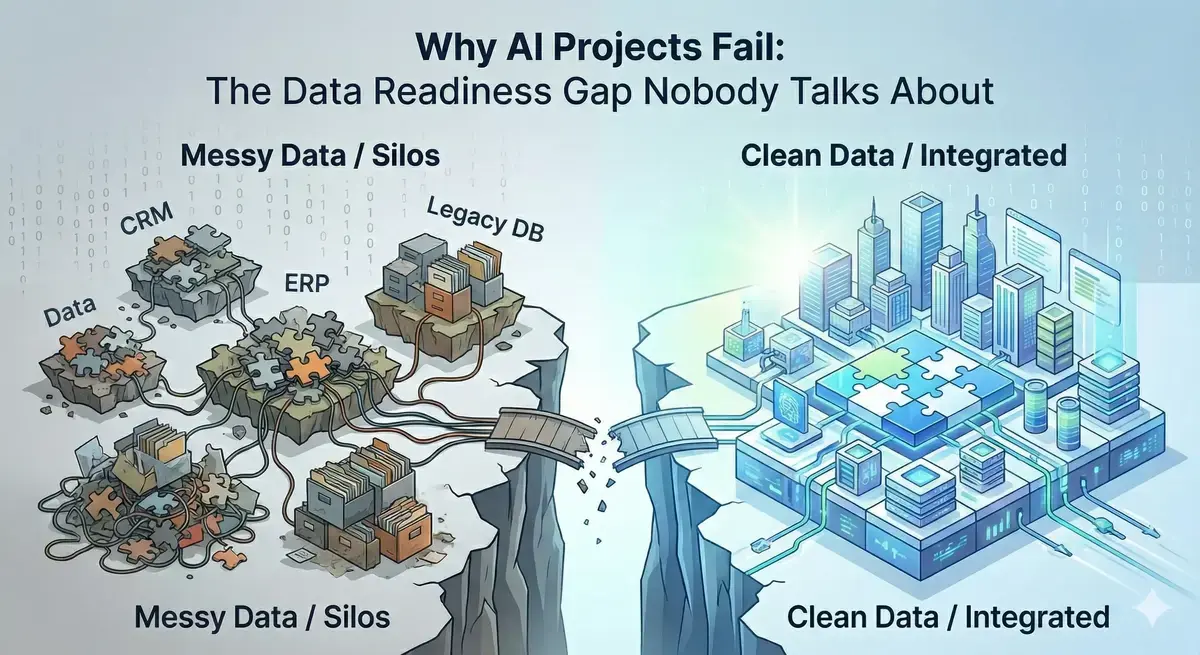
The data readiness gap is the disconnect between an organization's existing data infrastructure and what AI systems require to function effectively. It is the primary reason 60% of AI projects fail. The gap is not about data quality but about data accessibility: most companies have decent data scattered across fragmented systems that cannot communicate with each other.
The Uncomfortable Truth
Gartner projects that 60% of AI projects will be abandoned through 2026 due to lack of AI-ready data. If you've been in enterprise technology long enough, you've seen this movie before—just with different buzzwords. Cloud migrations that stalled. Digital transformation initiatives that became digital sprawl. Now it's AI's turn.
The default explanation is "data quality." Executives nod knowingly. Vendors offer data cleansing tools. Consultants propose multi-year governance programs. Everyone moves on, having named the problem without actually solving it.
But "data quality" is a cop-out. It's vague enough to be unfalsifiable and specific enough to sound technical. It lets everyone off the hook: the project failed because the data wasn't good enough—not because we made bad decisions.
Here's what I've learned after 25 years in enterprise technology, including time at Microsoft, Citrix, and Confluent: The problem isn't bad data. It's inaccessible data trapped in fragmented systems.
Most mid-market companies have decent data. They've been collecting customer information, transaction records, and operational metrics for years—sometimes decades. The data exists. What doesn't exist is a coherent way to access it, reconcile it, and use it. And until you recognize that distinction, every AI initiative will hit the same wall.
Let me show you what data readiness actually means—and how to assess whether your organization has it.
The Statistics Nobody Wants to Believe
Before we dig into causes, let's establish the scale of the problem. These numbers are brutal, and they come from sources that have no incentive to exaggerate failure rates.
The headline numbers:
- 95% of generative AI projects fail to move from pilot to production (MIT, 2025)
- 42% of companies abandoned most of their AI initiatives in 2025—up from 17% in 2024 (S&P Global)
- 80%+ of AI projects fail overall—roughly double the failure rate of non-AI technology projects (RAND Corporation)
The underlying causes:
- The majority of organizations lack proper data management infrastructure for AI, according to Gartner
- Most business leaders rate their organization's data quality as average or worse
- Organizations with poor data quality experience 60% higher project failure rates
Let that sink in. Nearly half of companies that started AI projects in 2024 had abandoned most of them by 2025. The abandonment rate more than doubled in a single year. Understanding the five dimensions of AI readiness helps explain why these failures are so predictable.
These aren't stupid companies. They're not running inadequate teams or using outdated technology. Many of them hired expensive data scientists, purchased leading AI platforms, and followed vendor best practices. They did everything "right."
And they still failed.
When the failure rate is this high and this consistent across industries, the problem isn't execution. It's structural. There's something fundamentally wrong with how organizations approach AI readiness—and it starts with misunderstanding what "data readiness" actually requires.
Data Quality vs. Data Architecture: The Critical Distinction
When someone says "data quality," they're implying the data itself is wrong. Incorrect values. Missing fields. Duplicate records. Garbage in, garbage out.
That's real, but it's rarely the fatal problem.
The fatal problem is fragmentation. Most companies have reasonable data—scattered across 30 different systems that don't talk to each other.
Here's what fragmentation actually looks like:
Siloed Systems
Your CRM has customer data. So does your ERP. So does your HR system (for employee customers), your finance system (for billing), and your support platform. Each system has a record for "Acme Corporation"—and none of them match. Different addresses. Different contact names. Different account IDs. Which one is right? All of them. And none of them.
No Programmatic Access
That legacy system from 2008 contains 15 years of transaction history. Critical data. Irreplaceable. And the only way to get it out is a manual export to CSV, which takes three days and requires involvement from someone who retired two years ago but still consults part-time. Try building an AI model on that.
Legal and Contractual Restrictions
The data exists. You can see it. But you can't use it. Customer contracts from 2015 didn't anticipate AI training. Privacy regulations restrict cross-border data movement. Your data sharing agreement with a partner explicitly prohibits automated analysis. The data is there; it's just legally radioactive.
Schema Inconsistency
"Customer" in Salesforce means anyone who's ever been contacted by sales. "Customer" in your ERP means entities with active contracts. "Customer" in your support system means anyone who's submitted a ticket—including prospects, partners, and people who bought your product secondhand. When your AI model learns to predict "customer churn," which definition of customer is it using?
No Single Source of Truth
When customer data conflicts across systems, which system wins? If Salesforce says the customer is in California and SAP says Texas, who's right? Most organizations don't have a documented answer. Individual employees know which system to trust for which data type—institutional knowledge that lives in people's heads and disappears when they change jobs.
A typical scenario:
A $200M manufacturing company wants AI to predict customer churn and trigger proactive retention outreach. Reasonable goal. Proven use case. Should be straightforward.
Customer relationship data lives in Salesforce. Order history is in SAP. Support ticket patterns are in Zendesk. Payment behavior is in Stripe. Product usage telemetry—for customers using the mobile app—is in a separate analytics database.
To train a churn prediction model, you need to unify these data sources. Match customer records across systems. Reconcile different ID schemes. Normalize date formats and naming conventions. Handle the 12% of records that don't match cleanly across systems.
What was positioned as a three-month AI pilot becomes an 18-month data integration project. The AI model—the part everyone was excited about—takes six weeks. The other 16 months? Data plumbing. A single failed AI pilot like this can burn $500K-$2M in mid-market companies. This is precisely why AI pilots fail to scale—the data foundation was never solid.
The data in each system is fine. It's a data architecture problem—and no amount of data cleansing will fix it.
Building your AI governance framework? Our AI Governance service helps you manage risk while enabling innovation.
Ready to assess your organization's AI readiness? The Assessment evaluates your technology, data, people, and processes to identify what's blocking your AI success. Schedule your assessment →
Where AI Project Time Actually Goes
Here's a pattern that should change how you budget AI projects: data scientists routinely spend the majority of their time on data preparation rather than actual analysis — a well-documented pattern across the industry.
Let that recalibrate your expectations.
When you hire a data science team or engage an AI vendor, you're imagining people building sophisticated models, tuning algorithms, and deploying intelligent automation. What you're actually paying for—most of the time—is people writing Python scripts to extract data from legacy systems, reconcile conflicting records, and transform messy inputs into something a model can consume.
A realistic project timeline for enterprise AI:
| Phase | Duration | Actual Work |
|---|---|---|
| Discovery | Months 1-2 | Figuring out what data exists and where it lives |
| Data Engineering | Months 3-6 | Extracting, cleaning, transforming, reconciling |
| Model Development | Months 7-8 | Building and training the actual AI model |
| Testing & Iteration | Months 9-12 | Validating outputs, handling edge cases |
| Deployment | Month 13+ | Production rollout—if you get there |
Two months of discovery. Four months of data plumbing. Two months of actual AI work. Three months of testing. And deployment is a question mark.
This timeline explains why AI projects blow past budgets and why ROI projections never materialize. You staffed the project expecting to pay data scientists to do data science. You ended up paying data scientists to do data engineering—at data science rates.
It also explains why AI deployments create new overhead: when AI is trained on fragmented, inconsistent data, it produces fragmented, inconsistent outputs. Employees end up spending hours each week fact-checking AI-generated content instead of trusting it.
You didn't automate work. You added a verification step. For organizations looking to break this cycle, data quality quick wins can build the foundation without requiring a multi-year transformation project.
What success looks like: One mid-market client consolidated from 40 systems to 12 before starting AI work. Their first production model deployed in 11 weeks—not 18 months.
The Architecture First Approach
The pattern across successful AI deployments is consistent: fix the architecture, then deploy AI.
This is counterintuitive. When everyone is racing to implement AI, the advice to slow down and work on infrastructure sounds like the wrong priority. But the math is unambiguous.
Fewer systems = less reconciliation = faster AI deployment = better ROI.
If customer data lives in one authoritative system instead of five conflicting ones, you don't need a data reconciliation project before every AI initiative. The data is already unified. The AI project becomes a deployment problem—connecting the model to clean data—rather than a data problem.
The architecture-first sequence:
-
Inventory all systems containing data relevant to your target use cases. Not just the obvious ones—every spreadsheet, shadow IT tool, and legacy database that touches the data.
-
Map overlaps and conflicts. Where does the same entity (customer, product, employee) appear in multiple systems? Where do definitions diverge? Where do records conflict?
-
Designate authoritative sources. For each data type, which system is the single source of truth? Document it. Enforce it. When systems conflict, the authoritative source wins.
-
Build integration or eliminate redundancy. Either create an integration layer that synchronizes data from the authoritative source to downstream systems, or—better—eliminate the redundant systems entirely. Every system you remove is a reconciliation you never have to do again.
-
Then deploy AI. Now your AI initiative is working with unified, consistent data. The model training is straightforward. The outputs are trustworthy. The deployment timeline is predictable.
The counterintuitive truth: delaying AI deployment by six months to simplify your architecture often delivers ROI faster than starting immediately.
A six-month architecture project followed by a three-month AI deployment beats a nine-month AI project that fails and restarts, or an eighteen-month AI project that's really a data integration project in disguise.
The fastest path to production AI is usually the indirect one.
What "AI-Ready Data" Actually Means
Let me demystify "AI-ready data." It doesn't mean perfect data. Perfect data doesn't exist, and waiting for it is a recipe for paralysis.
AI-ready data meets five practical criteria:
1. Accessible via API or standard interface The data can be retrieved programmatically, without manual exports or human intervention. If getting the data requires someone to run a report and email a spreadsheet, it's not AI-ready.
2. Documented schema Someone—ideally something—can tell you what each field means, what values are valid, and how the data relates to other data. If understanding the data requires calling someone who's been with the company for 20 years, it's not AI-ready.
3. Clear ownership A specific team or role is responsible for the data's accuracy and completeness. When something's wrong, there's someone to fix it. When there's a question, there's someone to answer it. Orphaned data is never AI-ready.
4. Reasonable quality Not perfect—reasonable. Missing values should be the exception, not the norm. Obvious errors should be rare. The data should reflect reality closely enough that a model trained on it will produce useful outputs.
5. Legal and compliant for intended use You have the right to use this data for AI training and inference. Privacy regulations are satisfied. Contractual restrictions don't prohibit the use case. If you're not sure, it's not AI-ready—at least not until legal signs off.
Warning signs your data isn't ready:
-
Excel exports are the primary data access method. If "getting the data" means running a report and saving it as a spreadsheet, you have an accessibility problem.
-
Nobody knows where certain data lives. "I think it might be in the old system" is a red flag. AI projects require comprehensive data inventories.
-
"We'd have to ask IT to pull that manually." Manual intervention in data access is a scalability killer. AI needs automated, repeatable data pipelines.
-
Data definitions vary by department. When sales, finance, and operations use the same term to mean different things, your AI will learn from conflicting signals.
If any of these sound familiar, you have architecture work to do before your AI projects will succeed. The good news is that starting with AI strategy focused on outcomes can help you prioritize which data problems to solve first.
The Path Forward
AI projects fail because of architecture, not algorithms. The 60% abandonment rate, the 95% pilot failure rate—these are the consequence of decades of accumulating systems without consolidating data.
The fix is simpler architecture. Consolidate systems where possible. Eliminate redundant data stores. Designate authoritative sources and enforce them. Build integration layers that maintain consistency. Do this work before you deploy AI, not during.
Most companies don't need better data science. They need better data plumbing.
Frequently Asked Questions
Q: Why do AI projects fail?
A: AI projects fail primarily due to data architecture issues, not technology limitations. The main causes are fragmented data across siloed systems, lack of programmatic data access, no single source of truth, and schema inconsistency across platforms. Data scientists routinely spend the majority of their time on data preparation rather than actual AI development — a well-documented pattern across the industry.
Q: What is AI-ready data?
A: AI-ready data meets five criteria: (1) accessible via API or standard interface without manual exports, (2) documented schema explaining field meanings and relationships, (3) clear ownership with someone responsible for accuracy, (4) reasonable quality with missing values being exceptions, and (5) legal compliance for intended AI use including privacy regulations.
Q: How long does it take to prepare data for AI?
A: Traditional enterprise AI projects spend 4-6 months on data engineering before any model development begins. However, organizations that consolidate systems and fix architecture first can deploy production AI in as little as 11 weeks. The key is addressing fragmentation before starting AI work.
Q: What percentage of AI projects get abandoned?
A: According to Gartner, 60% of AI projects will be abandoned through 2026 due to lack of AI-ready data. Additionally, 95% of generative AI projects fail to move from pilot to production, and the abandonment rate more than doubled between 2024 and 2025.
Take the Next Step
Data architecture problems don't fix themselves—but they are fixable. Tributary helps mid-market companies navigate AI implementation with clarity and confidence.
Take our free AI Readiness Assessment → to discover where your data architecture stands, or schedule a Strategic Assessment to get a clear-eyed diagnosis of what's blocking your AI success and a prioritized path forward.
Ready to Put This Into Practice?
Take our free 5-minute assessment to see where your organization stands, or talk to us about your situation.
Not ready to talk? Stay in the loop.
Get AI strategy insights for mid-market leaders — no spam, unsubscribe anytime.
Related Posts
View all posts