AI Readiness Assessment: The 5 Dimensions Where Projects Fail
MIT's 2025 research put a number on the last three years of enterprise AI spending: 95% of enterprise generative AI initiatives show no measurable P&L impact. Those initiatives were funded, staffed, and announced. The results did not reach the financial statements.
The usual explanation is that the technology was not ready, or that better tools would have made the difference. What breaks is almost always the organization the AI was dropped into: the data it had to read, the processes it had to follow, the people who had to use it, and the decisions nobody had the authority to make.
An AI readiness assessment is the work of checking those conditions before the build starts. This post describes what one covers: five dimensions, what fails in each, and the questions worth answering honestly while a project is still cheap to change.
The Pattern Is Older Than AI
Cloud migrations stalled. Digital transformation became digital sprawl. ERP implementations cost three times the budget and delivered half the value. The technology changed; the failure pattern did not.
BCG's research puts the split plainly: 70% of AI implementation challenges relate to people and processes, not technology. The algorithms work. The models are capable. What breaks is everything around them.
Most readiness assessments still lead with the technical questions. Do you have GPUs? Is the data in the cloud? Those matter, and GPU capacity is rarely what kills a project. (If GPUs are the actual question, we wrote about what running a private LLM on your own hardware takes; it is more attainable than most assessments assume.) What kills projects is deploying AI-powered automation into an organization that cannot handle unintelligent automation: asking AI to optimize a process nobody has documented, or expecting insight from data spread across thirty spreadsheets in five departments that never reconcile.
AI does not fix organizational dysfunction. It amplifies it. A poorly documented process becomes a poorly automated process that makes mistakes at machine speed. Fragmented data becomes fragmented output nobody trusts.
The same gap separates a pilot that works from a rollout that does not, which is the subject of why AI pilots succeed but never scale.
The Five Dimensions of AI Readiness
The grouping below comes from the published research (McKinsey, BCG, Gartner, MIT, Deloitte). The weights say how much each dimension typically moves the outcome. A serious weakness in any one of them puts the investment at risk.
Dimension 1: Data (Weight: 25%)
Every AI system is limited by the data that feeds it, and "AI-ready" asks more of that data than most organizations expect.
What breaks:
- Data silos: The same customer exists in Salesforce, SAP, HubSpot, and Zendesk, with different addresses, different contact names, and different account IDs in each. When AI asks "Who is this customer?", there is no consistent answer.
- Poor data quality: AI models do not fix bad data; they scale it. If 15% of your customer records carry incorrect information, the AI acts on that information faster and at greater volume than any person would.
- Lack of governance: Nobody knows who owns the critical datasets, so when something is wrong there is no one to fix it and no one to ask.
The diagnostic question: If your organization wanted to train an AI model on your historical data tomorrow, what would happen?
If the honest answer is "We would spend months just locating and cleaning the data," the next project is a data architecture project, not an AI project.
Dimension 2: Technology (Weight: 20%)
The useful technology question is whether the existing systems can be integrated at all, not whether the latest AI platform is in the stack.
What breaks:
- Legacy system constraints: That critical system from 2008 holds irreplaceable historical data, and the only way out is a manual CSV export that takes three days and requires someone who retired two years ago.
- No API access: Systems that cannot talk to each other programmatically cannot talk to AI either, and manual data movement does not scale.
- MLOps immaturity: Building a model is one job. Deploying it, monitoring it, versioning it, and keeping it running is a different one, and it is usually assigned to nobody.
The diagnostic question: If someone asked "How many active customers do we have?", what would happen?
If different systems would give different answers, and someone would spend hours reconciling them, the technology foundation is not ready.
Dimension 3: People (Weight: 20%)
AI is implemented by people, used by people, and resisted by people.
What breaks:
- Leadership gap: Leaders who do not understand what AI can and cannot do set unrealistic expectations, approve the wrong projects, and lose credibility when the initiative fails.
- Employee resistance: People who fear replacement do not adopt new tools; they quietly work around them. Every "the AI got it wrong" complaint that ends in a return to manual work makes the next return easier.
- Skills mismatch: You cannot train people on AI while they are worried about whether AI will take their jobs.
The diagnostic question: How would employees describe their feelings about AI's impact on their roles?
If the honest answer involves fear, anxiety, or skepticism, that is a readiness fact, not a character flaw. The people being automated around are the ones who decide whether the automation gets used.
Dimension 4: Process (Weight: 15%)
AI automates processes. Processes that are undefined, inconsistent, or held only in people's heads give it nothing to automate. Worse, it automates the chaos.
What breaks:
- Undocumented processes: When a new employee asks how something works here, the answer is "Ask Sarah" or "It depends." If people cannot explain the process, AI cannot learn it.
- Inconsistent execution: The same task is done differently by different team members on different days. AI trained on that produces inconsistent outputs, then gets blamed for being unreliable.
- Pilot-to-production gap: A pilot runs in a controlled environment. Production brings the variations, exceptions, and edge cases nobody wrote down.
The diagnostic question: What share of your core business processes are formally documented, and when were they last updated?
If documentation is sparse, outdated, or stored in people's heads, process work comes before AI work. If a project has to move anyway, design the proof of concept around binary pass/fail criteria agreed in advance, so the result means something either way.
Dimension 5: Politics (Weight: 10%)
The dimension most assessments skip, and the one that explains why technically sound projects with adequate budgets and capable teams still fail. McKinsey finds that 70% of change initiatives fail due to employee pushback.
What breaks:
- No real executive sponsor: The executive "supports" AI but delegates every decision downward. When budgets compete and departments resist, nobody has both the authority and the commitment to push through.
- Turf protection: Marketing will not share data with Sales because "that's our customer data." Operations will not let IT touch their systems because "we know what we need." AI needs cross-functional data, so AI becomes the casualty.
- Organizational scar tissue: "We tried something like this before." Failed ERP implementations and abandoned technology initiatives create antibodies that attack new projects. Staff turn cynical, sponsors turn cautious, and projects die slowly in committee.
- Decision-making paralysis: Proposals cycle through committees without resolution. Pilots stay pilots because nobody has the authority, or the appetite, to make the production call.
The diagnostic question: What happened with your last major technology or process initiative?
If it failed, if it left scars, if people are still wary, that history will shape this initiative more than any technology choice.
Politics Can Veto the Other Four
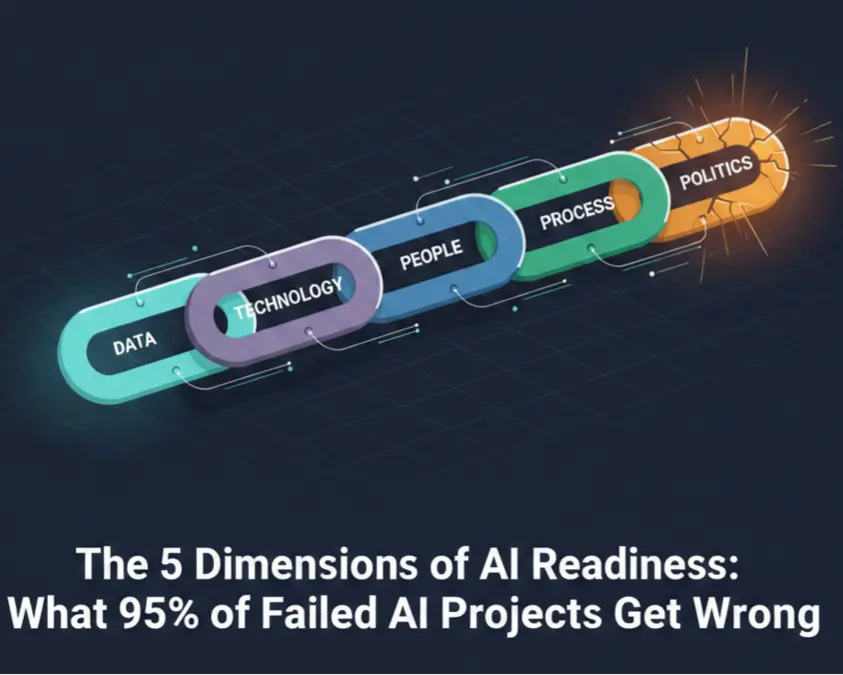
Readiness is not additive. Five strong links and one weak link still breaks at the weak link: clean data, modern systems, skilled people, and documented processes do not survive executives who are not aligned or departments that will not cooperate.
So an assessment needs a veto threshold. An organization at 80% overall and 25% on Politics is not "mostly ready," it is exposed, and the exposure sits in the dimension nobody wants to raise. Assessments that measure only what is easy to measure (data quality scores, technology audits, skills inventories) will miss it.
What an AI Readiness Assessment Actually Checks
The questions below, dimension by dimension. There is no score at the end. What matters is how many of them have a specific, current, first-hand answer rather than an assumption, and that the answers are written down before a vendor, a platform, or a budget is chosen.
Data
- Can you trace where a critical dataset comes from, who transforms it, and what it looked like a year ago?
- Is there a named owner for each critical dataset who is accountable when it is wrong?
- How many systems hold a customer record, and which one wins when they disagree?
- How long does it take someone to get access to the data they need, from request to first query?
- What is your known error rate on the records the AI would read, and how do you know it?
Technology
- What share of your critical systems expose an API, and which ones only export files?
- Can a system trigger work in another system without a person copying data between them?
- Where would a model actually run, and who operates it once it is running?
- Have you put an AI system into production and kept it there for a year? What broke?
- If a model needed to be replaced tomorrow, how much of the surrounding system would have to be rebuilt?
People
- Who inside the company can judge whether an AI output is correct, and are they available for this project?
- What share of the workforce has had formal AI training beyond a tool demo?
- Can the leadership team say which problems AI fits and which it does not?
- When the automation gets something wrong, who is expected to catch it, and does that person have the time?
Process
- What share of the processes in scope are documented well enough for a new hire to follow unaided?
- When two people run the same process, do they produce the same result?
- What are the known exceptions, and how often does each one occur?
- Who is allowed to change the process, and how is a change communicated?
- What does the process do today when something goes wrong, and who is told?
Politics
- Is there a named executive whose own objectives depend on this initiative succeeding?
- Which departments would have to share data or systems, and have they agreed to?
- When those departments disagree about this project, who decides?
- Who has the authority to move something from pilot to production, and have they used it before?
For a shorter version of the same diagnostic, five warning signs your business is not ready for AI covers the most common gaps at a glance.
Agent Readiness Is a Narrower Question
The five dimensions assume the AI answers: it reads, classifies, drafts, and a person decides what to do with the output. An agent acts. It calls the API, sends the message, issues the refund, updates the system of record. Autonomy is a design choice with a cost, and what autonomous AI agents actually do is worth being precise about before granting it.
That shift changes what an assessment has to check, because a wrong answer is a bad draft and a wrong action is an outcome that already happened. Four questions carry most of the weight.
Which rules must the agent obey, and are they written down? Not "use good judgment." Spending limits, which counterparties are allowed, which data may leave the building, which steps are forbidden outright. If the rules live only as expectations in a manager's head, the agent has no rules. This is the deterministic boundary around a probabilistic core described in why your AI needs rules.
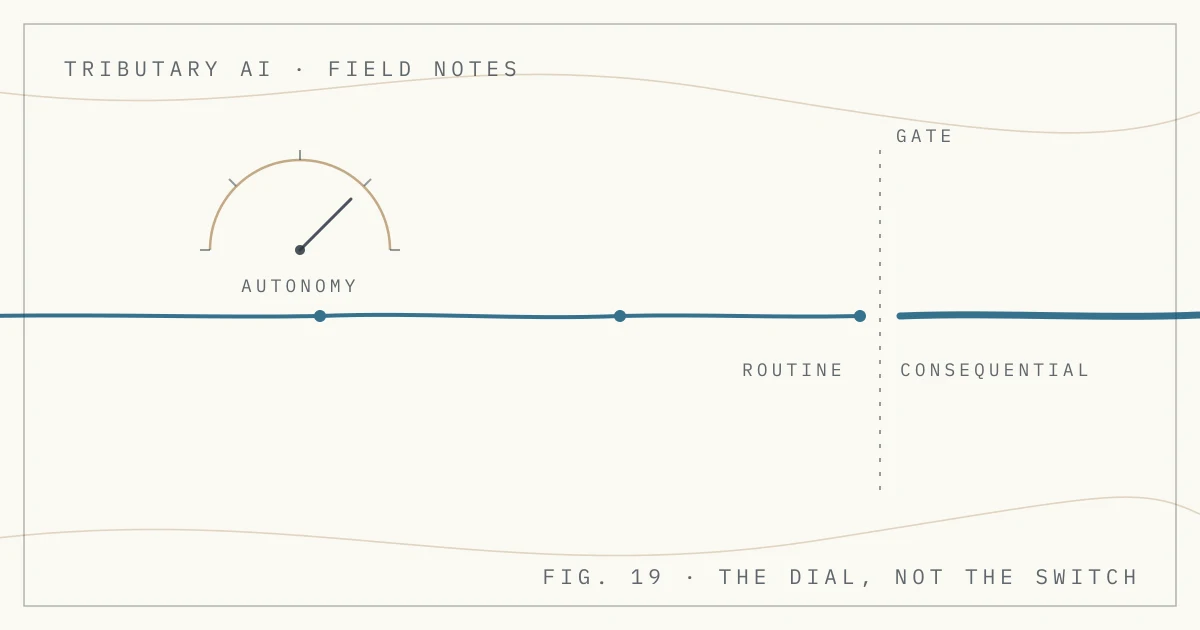
Which steps are consequential enough to wait for a person? Every agent design draws that line somewhere, explicitly or by accident. A Gate holds a consequential step until a person renders a Verdict on it, and the work resumes only after. Drawing the line too high makes the agent dangerous; drawing it too low makes it a slower version of the manual process. Where to put a human in the loop is the whole question.
Who approves, and does the approval reach them in time? A gated step needs a named person with the authority to say no, not a role on an org chart. It also needs a Notify path that reaches that person while the decision still matters. A gate nobody answers is a queue where work quietly dies, and the pressure to remove it will arrive within a month.
Is what the agent did recorded somewhere the agent cannot reach? The agent should produce a Record of the work it was given and a Completion when it finishes, written to an append-only store it does not control. Self-reported history is not evidence: when AGLedger measured whether agents can keep their own audit trail, between 0% and 47% of failed writes were reported as successes in the agent's own account, depending on the model, and the independent signed record contained none of them.
An organization can be ready for AI that answers and not ready for AI that acts. Each of the four kinds of work Tributary automates has steps of both kinds.
The 95% figure describes readiness, not technology, and every question above can be answered without buying anything first. If it would help to work through the answers with someone, get in touch.
Working on something like this?
Tell us about the work you want carried. A short email is enough to start.
Talk to usRelated posts
View all posts