Agentic WorkflowAgentic AIAI AgentsAutomation
What Is an Agentic Workflow? A Working Definition and a Field Test
An agentic workflow is an automation in which a model decides the next step at runtime: which tool to call, in what order, whether to retry, and when the work is done. A conventional workflow executes a sequence someone designed in advance; an agentic workflow is handed a goal and a set of tools, and it charts its own course through them.
That's the whole definition. Everything else in the term's marketing orbit ("autonomous digital workforce," "self-directed AI employees") is decoration on top of one architectural choice: who picks the next step, the designer or the model?
The Two Shapes of Automation
A pipeline is a fixed sequence: when an invoice arrives, extract the fields, match the PO, post to the ledger, notify the approver. Every run takes the same path. A model may sit inside a step (reading the invoice), but the route is designed once and executed forever. Pipelines are predictable, testable, and cheap to run. Most business automation should be pipelines, including most of what gets sold as agentic.
An agentic workflow hands the route to the model: here's the goal, here are the tools (search the CRM, read the mailbox, draft an email, create a ticket), go. The model loops: assess the situation, pick an action, observe the result, pick again, stop when the goal is met. The workflow's path is different on every run because every situation is different.
The value of the agentic shape is exactly the variance it absorbs. When the incoming work is too varied for a designer to enumerate every path (a support request that might need three lookups or none, an escalation that depends on what the first answer revealed), a fixed pipeline either explodes into a thicket of branches or punts back to a human. The agentic loop covers the variance without the thicket.
The cost of the agentic shape is everything predictability was buying you: runs differ, errors are creative, testing is statistical rather than exact, and every extra decision is another model call on the meter.
The Anatomy of an Agentic Workflow
Every production agentic workflow we've seen work has the same six parts:
- A goal with a "done" test. Not "handle the ticket" but "the customer has an answer, or the ticket is escalated with a summary." If you can't state what done looks like, the loop can't stop well. Models declare intent readily and close loops badly; in our own testing against Google's A2A protocol, the fix was interface design, not prompting.
- A bounded toolset. The model chooses among tools you gave it, and nothing else. The toolset is the workflow's blast radius, and its size is a completion variable: in our own testing across three LLM providers, 36 available tools took task completion to zero while 10 focused tools achieved full lifecycle closure.
- Context management. The loop accumulates history, and long histories degrade decisions. We watched this fail visibly in our own game-building experiments: the model doesn't get dumber late in a long run, it gets inconsistent.
- Stop conditions. Step budgets, cost budgets, and loop detection. An agent without a budget is a subscription you didn't mean to buy.
- An escalation path. The best next step is often "hand this to a person, with a summary." Workflows that can't escalate gracefully fail loudly.
- A person over the consequential steps. Reading and drafting can run free; sending, paying, and deleting wait for an approval. The agentic loop chooses the route; it doesn't get to choose the stakes.
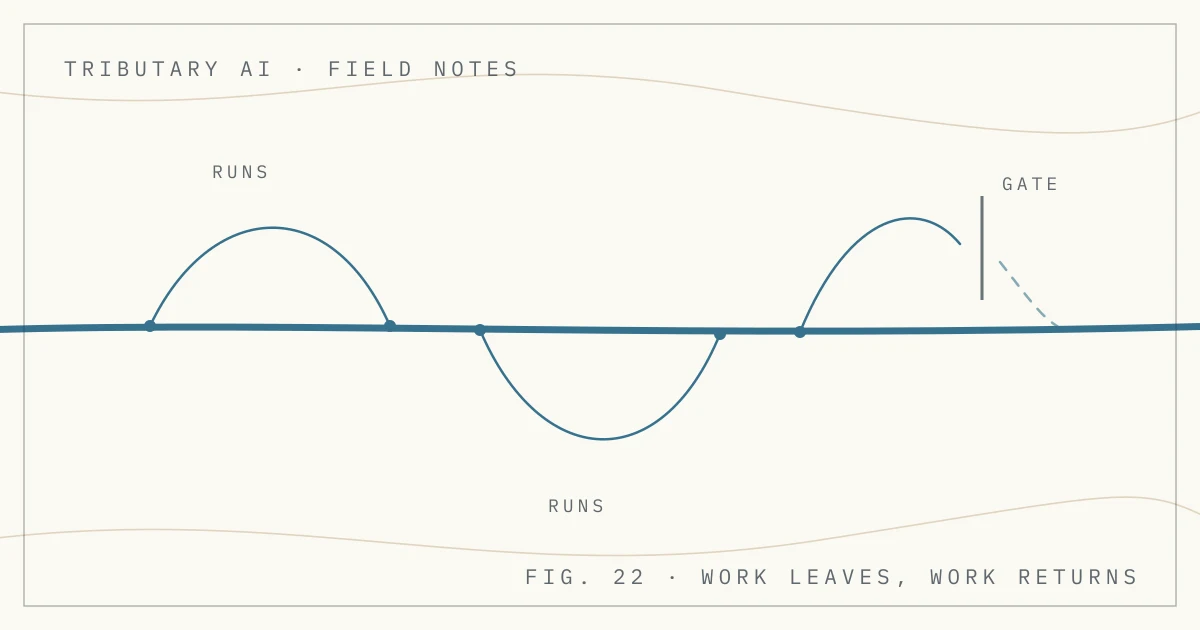
Notice how much of that anatomy is deterministic scaffolding. The reliable version of an agentic workflow is rules around a reasoning core, not a model in an empty room. The effect is measurable: in one of our experiments, a deterministic gate flipped the weakest model from 0/3 to 3/3 on finishing its own interrupted work.
A Five-Question Field Test
Before making a workflow agentic, we run it through five questions. A pipeline wins any question it can answer.
- Does the variance actually require choice? If 90% of runs would take the same path, build the pipeline for the 90% and route the rest to a person. Choice you don't need is risk you don't need.
- Is the environment observable? The model can only choose well if it can see the state: the record, the history, the result of its last action. Agentic workflows on top of messy, partial data make confident wrong turns.
- Is a wrong step recoverable? Drafts, lookups, and classifications are reversible. Payments and deletions are not. Agentic freedom belongs on the reversible side of the line.
- Is an attempt cheap enough to retry? Statistical systems earn reliability through retries. If one attempt is expensive (a long job, a rate-limited API, a customer-visible action), the loop can't afford to learn.
- Can you state the "done" test in one sentence? If not, the goal isn't ready to delegate. Sharpen the goal first; often the sharpened goal turns out to be a pipeline.
Where Agentic Workflows Fit Real Work
Mapped against the four categories of work we automate:
- Intake is mostly pipeline. Documents arrive, get read, get routed. Low variance, high volume: the pipeline's home field.
- Triage is where agentic-lite earns its keep: the model decides the next step for the ambiguous minority (which team, what priority, ask a clarifying question or escalate) while rules handle the clear majority.
- Drafting benefits from short agentic loops: look up the account, check the history, draft, self-review against a checklist, present for approval.
- Reporting is pure pipeline. Anyone selling you an agentic report generator is selling you variance in the one place nobody wants it.
The honest summary: agentic workflows are a tool for the ambiguous slice of the work, and the ambiguous slice is real but thin. Companies get value from the agentic shape when they deploy it surgically, inside automations that carry work from trigger to done on a deterministic spine. How much of that spine runs without a person is its own decision: autonomy is a dial set per step. Companies get burned when they aim it at everything, because they bought the decoration instead of the definition.
If you're weighing which of your workflows deserve the agentic shape, that's a conversation we have often: talk to us.
Working on something like this?
Tell us about the work you want carried. A short email is enough to start.
Talk to us