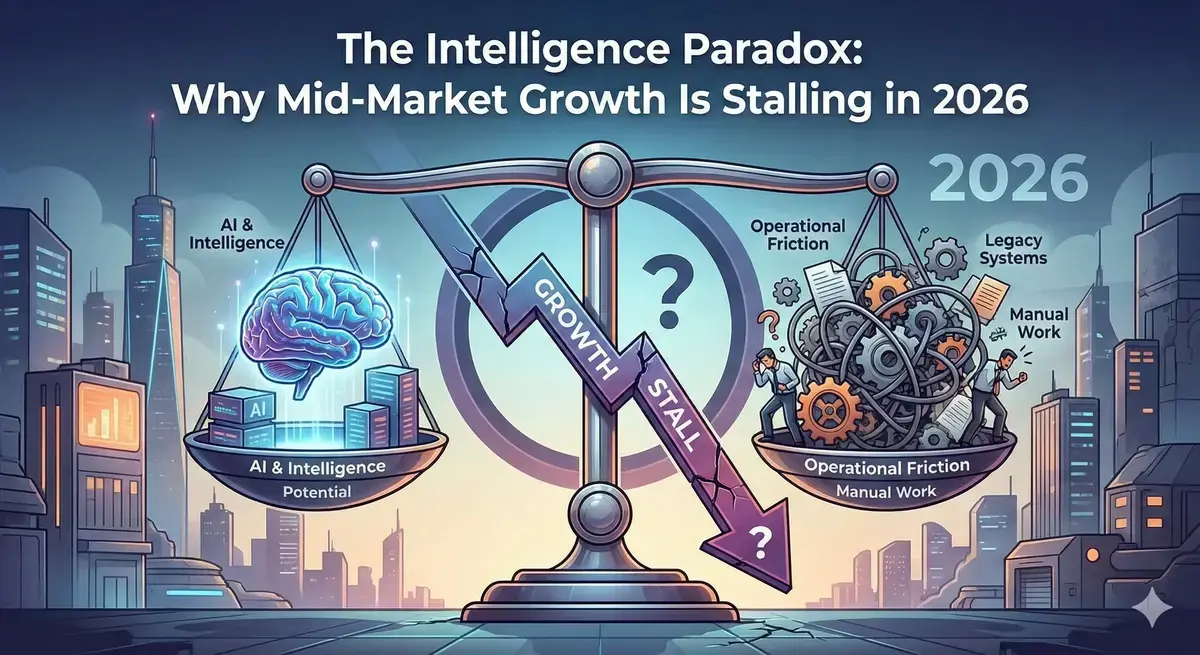
The Intelligence Paradox: Why Mid-Market Growth Is Stalling in 2026
Here's the uncomfortable reality facing mid-market companies in 2026: intelligence has never been cheaper, but moving that intelligence through your organization has never been more expensive.
AI can now generate reports in seconds that used to take analysts days. It can write functional code, analyze P&L statements, summarize customer feedback, and draft strategic recommendations—all at marginal cost approaching zero. The raw cognitive work that used to require expensive human talent is rapidly commoditizing.
And yet, operational costs keep climbing. Headcount keeps growing. The promise of efficiency gains remains stubbornly unrealized.
The problem isn't the AI. It's the plumbing.
The Real Bottleneck: Movement, Not Intelligence
Walk through any mid-market company and you'll find the same pattern: expensive, talented people spending their days as manual glue between disconnected systems.
Your finance team exports data from the ERP, reformats it in Excel, and uploads it to the reporting tool. Your operations manager copies information from the CRM into the project management system. Your analysts pull data from three different dashboards, reconcile the discrepancies, and create a unified view in PowerPoint.
This isn't knowledge work. It's data janitorial work. And it's consuming your most valuable human capital.
The math is brutal: You're paying $80,000+ salaries for people to do work that AI could handle—if only the systems were connected. The intelligence to process the information is essentially free. The human labor to move information between systems is not.
This is the Intelligence Paradox: the smarter our tools become, the more obvious it is that our infrastructure can't use that intelligence.
How We Got Here
Nobody designed this mess intentionally. It accumulated through three predictable patterns:
The "Best of Breed" Trap
Every department bought the best tool for their specific function. Sales got Salesforce. Marketing got HubSpot. Finance got NetSuite. Operations got Monday.com. HR got Workday.
Each tool is excellent at what it does. None of them talk to each other without significant effort. The result: islands of capability separated by oceans of manual work.
The irony is that "best of breed" was supposed to be the sophisticated choice—avoiding vendor lock-in, getting specialized functionality. Instead, it created a different kind of lock-in: you're now locked into the manual processes that connect everything.
Organic Complexity
Software accumulates like sedimentary rock. Each year adds new layers: a tool to solve this problem, a workaround to handle that edge case, a custom integration built by someone who left three years ago.
Nobody has a complete map of how information actually flows through the organization. The documentation, if it exists, describes how things were supposed to work, not how they actually work. Tribal knowledge fills the gaps.
This organic complexity creates technical debt that compounds over time. Every new system has to integrate with the existing mess, making the mess messier. These data architecture challenges are a leading cause of AI project failure.
Maintenance Over Strategy
Your IT team isn't ignoring the integration problem. They're drowning in it.
Between keeping legacy systems running, managing security patches, responding to support tickets, and handling the endless small requests from every department, there's no bandwidth for strategic infrastructure work.
The people who could fix the problem are too busy managing the symptoms of the problem.
Why Internal Teams Can't Solve This
If the problem is so obvious, why hasn't it been fixed? Three organizational dynamics work against internal solutions:
The Perfection Trap
"We can't automate until we have perfect data."
This sounds reasonable. It's actually a recipe for permanent paralysis. Your data will never be perfect. Waiting for perfection means waiting forever.
The truth is that good integration work improves data quality as a byproduct. Connecting systems forces data standardization. Automation surfaces inconsistencies that manual processes hide. You don't need perfect data to start—you need to start to get better data.
The Bridge Gap
The people who see the cost (finance leadership, executives) don't understand the systems. The people who understand the systems (IT, operations) don't have visibility into the strategic cost.
When the CFO looks at the P&L, they see headcount. They don't see "12 FTEs worth of effort spent on data movement." When the IT manager looks at the infrastructure, they see technical debt. They don't see "this fragmentation is costing us $1.2M annually in operational inefficiency."
Without a bridge between these perspectives, the business case never gets made clearly enough to drive action.
Operational Inertia
The people best positioned to redesign these workflows are the ones currently executing them. And they're fully consumed by the current broken version.
Your operations lead could probably design a much better process. But they're spending 50 hours a week keeping the current process from falling apart. There's no slack in the system for improvement work.
This creates a vicious cycle: the worse the process, the more time it consumes, the less capacity there is to fix it.
Ready to assess your organization's AI readiness? The Assessment evaluates your technology, data, people, and processes to identify what's blocking your AI success. Schedule your assessment →
Why This Matters Now
The Integration Paradox has always existed. But three factors make 2026 the year it becomes critical:
The AI J-Curve
Agentic AI systems can now automate complex, multi-step workflows that were previously impossible to touch. An AI agent can handle an entire process—if it can access the necessary systems and data.
But agents can only work with what's connected. If your customer data lives in one system, your inventory data in another, and your pricing rules in a third—with no integration between them—no amount of AI sophistication can help.
Companies that solve the integration problem will ride an exponential curve of AI-enabled automation. Companies that don't will watch from the sidelines as the gap widens.
The Talent Pivot
Your best people are leaving.
High performers didn't sign up to be human middleware. They want to solve interesting problems, make strategic decisions, and create value. When they spend their days copying data between systems, they start updating their LinkedIn profiles.
Meanwhile, the job market is shifting. Roles focused on information transformation—converting data from one format to another, reconciling systems, creating reports—are being automated or eliminated across the economy.
A useful framework: If a job is mostly converting information into other information, AI will dominate it. If a job is choosing under uncertainty or bearing consequences, AI will assist it. If a job creates obligation or meaning, humans will own it.
Organizations that trap their talent in the first category will lose them to organizations that deploy them in the second and third.
The Real Cost of Waiting
Technical debt compounds. Every month you don't address integration problems:
- More data accumulates in disconnected systems
- More processes calcify around manual workarounds
- More institutional knowledge gets buried in undocumented workflows
- More opportunities for AI-enabled efficiency pass you by
The organizations solving this problem now are building capabilities their competitors will take years to replicate. The gap isn't linear—it's exponential.
The Path Forward: Active Architecture
The goal isn't building a "perfect" data warehouse. It isn't implementing a single monolithic platform. It isn't boiling the ocean.
The goal is Active Architecture: a pragmatic approach to breaking silos, pruning unnecessary systems, integrating core flows, and creating the connected infrastructure that modern AI requires.
What Active Architecture Looks Like
Breaking silos pragmatically: You don't need every system talking to every other system. You need the critical data flows connected—the ones that consume the most human effort or block the highest-value automation.
Pruning the tech stack: Most organizations have 30% more tools than they need. Eliminating redundant systems simplifies integration and reduces maintenance burden. Sometimes the best architecture decision is removing something.
Integrating core flows: Identify the 5-10 workflows that consume the most manual effort or create the most friction. Build robust, automated connections for those specific flows. Don't try to solve everything at once.
Re-allocating human capital: The real ROI isn't just efficiency savings. It's freeing your best people to work on customer-facing innovation, strategic initiatives, and the judgment-intensive work that humans do best.
The Practical First Steps
-
Map the manual glue: Where are your people spending time moving information between systems? Quantify it. Make the invisible cost visible.
-
Identify the high-value flows: Which integrations would have the biggest impact? Consider both effort saved and strategic value unlocked.
-
Start with connection, not perfection: Get systems talking to each other. You can optimize and refine once the connection exists.
-
Build for AI-readiness: Every integration you build should assume that an AI agent might eventually use it. That means clean APIs, documented data structures, and clear process logic.
The Choice
Every mid-market company faces the same decision in 2026: invest in the infrastructure that makes intelligence useful, or continue paying premium prices for manual data movement while competitors automate.
The Intelligence Paradox will resolve one way or another. Either you'll solve the movement problem and unlock the value of cheap intelligence, or you'll watch that value flow to competitors who did.
The technology exists. The path is clear. The only question is whether you'll act before the gap becomes insurmountable.
Take the Next Step
The Intelligence Paradox is real—but it's solvable. Tributary helps mid-market companies navigate AI implementation with clarity and confidence.
Take our free AI Readiness Assessment → to discover where your integration bottlenecks are, or schedule a consultation to discuss building the Active Architecture that makes intelligence useful.
Ready to Put This Into Practice?
Take our free 5-minute assessment to see where your organization stands, or talk to us about your situation.
Not ready to talk? Stay in the loop.
Get AI strategy insights for mid-market leaders — no spam, unsubscribe anytime.
Related Posts
View all posts