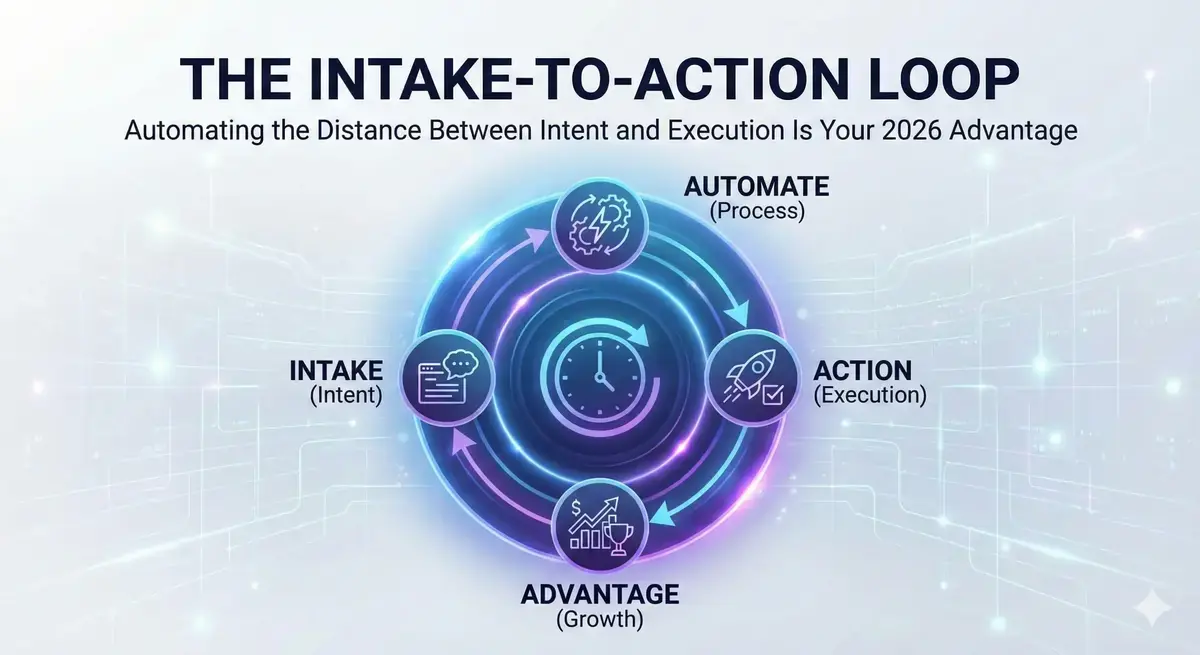
The Intake-to-Action Loop: Automate the Gap Between Intent and Execution
Looking for the full framework guide? This blog post introduces the Intake-to-Action Loop concept. For diagnostic questions, implementation phases, industry examples, and the complete ROI framework, see The Intake-to-Action Loop — Full Framework Guide.
Every day, your business receives signals from the outside world: customer emails, phone calls, order forms, support tickets, referrals, inquiries. Each signal represents intent. Each requires action.
The question that separates high-velocity companies from everyone else in 2026: how much distance exists between that intake and the action it demands?
For most mid-market companies, the answer is sobering. Requests sit in inboxes. Voicemails get transcribed and forwarded to someone who forwards them again. Order forms get manually keyed into systems. By the time intent becomes action, hours or days have passed, and competitive advantage has evaporated.
Intelligence is a commodity. Execution is your competitive advantage. This is the intelligence paradox that defines the current era.
Let me explain what this means in practice, and how to fix it.
The Intake-to-Action Loop Explained
The Intake-to-Action Loop is a framework for understanding how information flows through your organization and transforms into business outcomes. It has two critical stages:
Stage 1: Intelligent Intake
Every business ingests unstructured data constantly: emails from customers, phone transcripts from sales calls, scanned order forms, faxed referrals, chat messages, web form submissions. This is your intake.
In a modern architecture, this unstructured data gets automatically structured. The system recognizes what type of request it is, extracts the relevant information, and prepares it for action. No human reads it to decide what happens next.
Stage 2: Autonomous Action
Once intake is structured, the architecture triggers downstream actions without human intermediaries. A shipping reschedule request automatically updates the logistics system. An order form automatically populates your ERP. A customer complaint automatically opens a case, assigns it, and notifies the right team.
The outcome: you move from "reporting what happened" to "executing what is needed" in real-time.
Where Most Companies Are Stuck
Here's the diagnostic question: Who reads incoming information to decide what happens next?
If the answer is "a person," your process is architecturally frozen. That human reader has become a bottleneck that no amount of hiring, training, or management will fix. They're not adding value by reading and routing. They're acting as manual middleware between your customers and your capabilities.
This isn't a criticism of your team. It's a recognition that you're spending your most expensive resource (human judgment and attention) on tasks that architecture should handle.
IT Spend: The Complexity Tax
Here's an uncomfortable truth for 2026: technology spend should be shrinking as a percentage of revenue, not growing.
If your IT budget keeps expanding primarily to maintain disconnected tools, integrate legacy systems, and manage the complexity of your current stack, you're paying a complexity tax. Call it what it is: drag on your EBITDA.
Fragmentation as Friction
Most mid-market companies have accumulated 15-40 different software tools over the past decade. Each solved a problem at the time. Together, they create something far worse: data fragmentation that makes automation impossible.
Customer information lives in your CRM. Order data lives in your ERP. Support history lives in your ticketing system. Communication logs live in email. When a customer calls with an issue that spans multiple systems, your team becomes the integration layer, manually gathering context from disconnected sources.
This fragmentation isn't just inefficient. It's the reason you can't automate the intake-to-action loop. Automation requires integrated data. Disconnected tools make integration impossible without expensive middleware that adds more complexity.
Rationalization for Velocity
The alternative is deliberate rationalization: consolidating to a lean, integrated stack that serves as a prerequisite for high-velocity operations.
This doesn't mean replacing everything at once. It means evaluating every tool with a simple question: does this enable or block automation of our core workflows?
Tools that enable automation stay. Tools that create data silos or require manual intervention to function get marked for replacement or elimination.
The "Do More With Less" Pivot
"Do more with less" has become a cliche. But for companies that close the intake-to-action loop, it's a reality.
Manual Task Elimination
When architecture handles intake and triggers action, commodity tasks disappear from your team's workload. Consider what this means practically:
- Data entry elimination: Order forms, applications, and requests flow directly into systems without manual keying
- Routing automation: Requests go to the right person or system automatically, without triage
- Status updates: Customers get automatic updates without someone checking and communicating manually
- Basic decisions: Routine approvals and classifications happen automatically based on defined rules
These aren't high-value tasks. They're necessary friction that has existed because systems couldn't handle them. With modern architecture, they don't need humans.
Strategic Re-Allocation
When you eliminate commodity tasks, you don't eliminate the people. You redirect them toward work that creates differentiation:
- Customer relationships that require judgment and empathy
- Problem-solving for complex situations
- Process improvement and optimization
- Strategic planning and execution
- Innovation and new capability development
This is the real "do more with less" story: not headcount reduction, but capability amplification. The same team delivers dramatically more value because they're focused on high-leverage activities.
Recovering Your Most Expensive Capital: Human Focus
Your people's attention is your scarcest resource. Every hour spent on manual intake processing, data entry, and routine routing is an hour not spent on activities that differentiate your business.
The math is straightforward. If your average employee costs $80,000 fully loaded, and they spend 40% of their time on tasks that architecture could handle, you're paying $32,000 per person per year for manual middleware. For a 100-person company, that's $3.2 million annually spent on work that creates no competitive advantage.
Closing the intake-to-action loop recovers that capital.
Ready to move from strategy to execution? Learn how our AI Implementation service delivers results in 4-16 weeks.
Ready to assess your organization's AI readiness? The Assessment evaluates your technology, data, people, and processes to identify what's blocking your AI success. Schedule your assessment →
Practical Examples
Let's make this concrete with scenarios relevant to mid-market operations:
Example 1: Shipping Reschedule Automation
Before: Customer emails requesting a delivery reschedule. Customer service rep reads the email, looks up the order in the ERP, contacts logistics to check availability, coordinates a new date, updates the system, and responds to the customer. Elapsed time: 2-4 hours across multiple people.
After: Email arrives and is automatically parsed for intent (reschedule request) and key data (order number, preferred dates). System checks logistics availability, identifies options, updates the delivery schedule, and sends the customer a confirmation with tracking updates. Elapsed time: minutes. Human involvement: zero for routine cases.
Example 2: Order Form Processing
Before: Customer submits an order form (email, fax, web upload). Someone reviews it for completeness, manually enters data into the ERP, creates the order, triggers fulfillment, and sends confirmation. Errors happen. Rework is common.
After: Order form is ingested and automatically extracted regardless of format. Data validation happens automatically. System creates the order, triggers fulfillment workflows, and sends confirmation. Exception handling routes unusual cases to humans. Routine orders process without touch.
Example 3: Healthcare Referral Processing
Before: Specialist office receives faxed referral from primary care provider. Staff manually reviews the fax, enters patient information into the scheduling system, checks insurance eligibility, identifies available appointments, and calls the patient to schedule. Days pass between referral and scheduled appointment.
After: Fax is automatically converted to structured data. Patient information populates the system. Insurance verification runs automatically. Available appointments are identified. Patient receives an automated outreach with scheduling options. Staff involvement limited to complex cases requiring judgment.
Example 4: Email-to-Action Workflows
Before: Sales team receives inquiry emails that sit in inboxes until someone reads them, decides on classification, and takes appropriate action. Hot leads get delayed. Follow-ups get missed. Response time depends entirely on individual workload and attention.
After: Incoming emails are automatically classified by intent (new inquiry, existing customer question, support issue, partnership request). Each classification triggers appropriate workflows: inquiries get enriched with company data and routed to the right rep with context, support issues create tickets, partnership requests go to the relevant queue. Response time becomes consistent and fast.
The Strategic Conclusion
Stop maintaining the mess. Start accelerating the flow.
The objective is clear: automate the distance between customer request and company action. Every manual step in that journey is friction that slows your business and costs you money.
Getting there requires two things:
1. Prune Redundant IT Drag
Audit your current technology stack with honesty. Identify tools that create data silos, require manual integration, or add complexity without enabling automation. Develop a rationalization roadmap that consolidates toward an integrated architecture.
This isn't about chasing the newest technology. It's about creating the foundation that makes automation possible.
2. Break the Silos
Customer data, operational data, and communication data need to flow together. Not through manual effort, but through architecture that treats integration as a first-class requirement.
When data flows freely, you can automate the intake-to-action loop. When data is siloed, you can't. It's that simple.
The Transformation
Companies that close the intake-to-action loop transform information flow from a drag on operations into a high-velocity engine for execution. They respond faster, operate more efficiently, and free their teams to focus on work that actually creates competitive advantage.
In 2026, this isn't a nice-to-have. It's the new baseline for competitive operation.
The companies still relying on humans as manual middleware between intake and action won't disappear immediately. But they'll find themselves increasingly outpaced by competitors who've automated that distance away.
Take the Next Step
The distance between customer intent and company action is measurable—and fixable. Tributary helps mid-market companies navigate AI implementation with clarity and confidence.
Take our free AI Readiness Assessment → to discover where your intake-to-action gaps are, or schedule a consultation to discuss transforming your information flow into competitive advantage.
Ready to Put This Into Practice?
Take our free 5-minute assessment to see where your organization stands, or talk to us about your situation.
Not ready to talk? Stay in the loop.
Get AI strategy insights for mid-market leaders — no spam, unsubscribe anytime.
Related Posts
View all posts