The AI Maturity Ladder: A Realistic 18-Month Roadmap for Mid-Market Companies
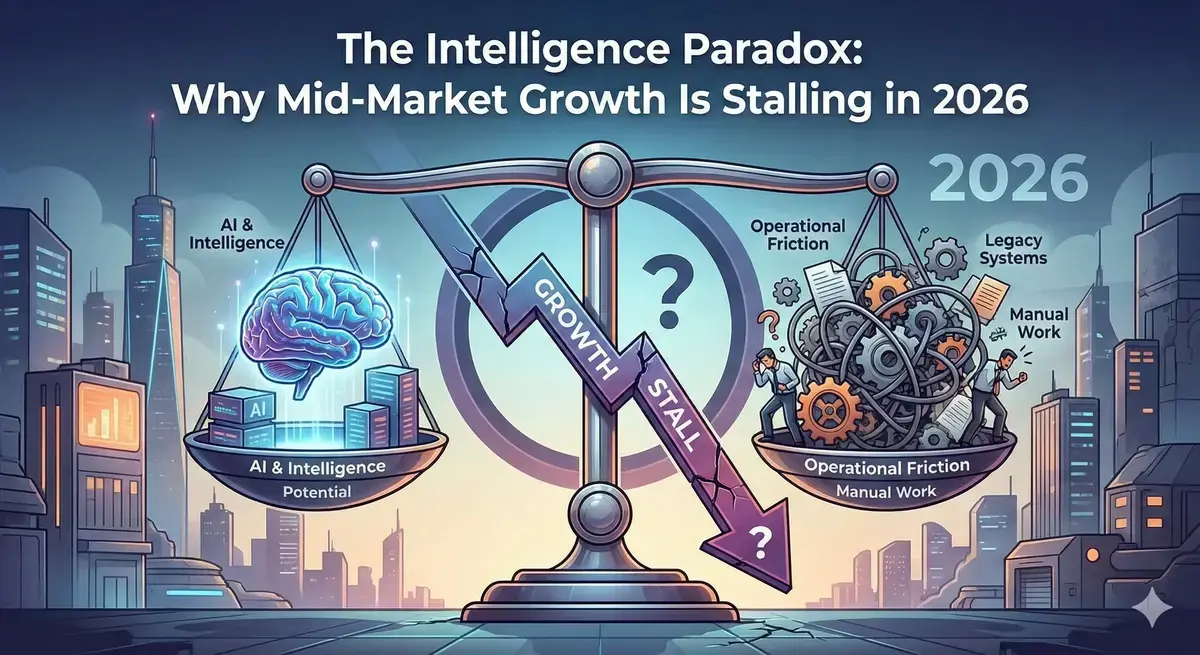
Every executive has seen the McKinsey slides and Gartner reports about AI transformation. What they often don't address: the vast majority of companies get stuck somewhere between pilot projects and production-scale deployment—and based on what we typically see in assessments, that gap is wider than most leaders expect.
After guiding dozens of mid-market companies through AI adoption, we've identified why most organizations stall—and what the ones who break through do differently. The key isn't having more resources or better technology. It's following a realistic maturity model with clear progression milestones.
Here's your 18-month roadmap from AI experimentation to competitive advantage.
The Sobering Reality: Why Most Companies Stall
Before we dive into the roadmap, understand what you're up against:
The Pilot Trap: In our experience working with mid-market companies, the majority of AI pilots never reach production. They prove technical feasibility but fail at organizational adoption. Many fall victim to common implementation mistakes that could have been avoided.
The Tool Graveyard: Organizations accumulate AI tools that individuals use but the company doesn't systematically leverage. Slack AI here, ChatGPT subscriptions there—no coordinated value creation.
The Integration Gap: Companies succeed at tactical AI applications but never achieve strategic integration where AI fundamentally changes how the business operates.
The Resource Mismatch: Leadership expects enterprise transformation with startup budgets and minimal organizational change.
The companies that reach full AI maturity don't skip these challenges—they anticipate them and build their roadmap accordingly.
The Three-Stage Maturity Model
Think of AI adoption as climbing a ladder with three distinct rungs. Each stage has different characteristics, success metrics, and resource requirements.
Stage 1: AI Tools (Months 0-6)
Individual productivity enhancement
Stage 2: AI Workflows (Months 6-12)
Team-level process integration
Stage 3: AI Agents (Months 12-18)
Organization-wide autonomous systems
Most companies jump directly to Stage 3 (autonomous AI agents) and wonder why they fail. The successful 1% methodically progress through each stage, building capability and organizational readiness as they go.
Stage 1: AI Tools (Months 0-6)
What This Stage Looks Like
Individuals across your organization use AI tools to enhance personal productivity. Think ChatGPT for writing, Copilot for coding, AI-powered research assistants, or automated transcription services.
Success at this stage means:
- 60%+ of knowledge workers actively using at least one AI tool weekly
- Documented productivity improvements in specific tasks
- Growing organizational comfort with AI capabilities
- Early champions emerging across departments
What You're Really Building
This isn't just about productivity gains. You're building:
- Organizational literacy: People learning what AI can and can't do through hands-on experience
- Cultural permission: Making AI experimentation safe and encouraged
- Use case library: Cataloging what works, what doesn't, and why
- Change capacity: Proving your organization can adopt new ways of working
Resource Requirements
- Budget: For most mid-market companies, Stage 1 runs $15K–$30K for software subscriptions, basic training, and governance setup. Companies with larger knowledge worker populations or stricter compliance requirements typically land at the higher end.
- Team: Part-time AI champion (usually a motivated manager), IT support for governance
- Time: 2-4 hours/month leadership attention, minimal individual overhead once tools are adopted
- Infrastructure: Basic software provisioning and usage policies
Common Pitfalls to Avoid
❌ Over-controlling tool selection: Trying to pick "the one right tool" creates analysis paralysis. Let teams experiment within security boundaries.
❌ No governance framework: Completely unrestricted access leads to data leaks and compliance issues.
❌ Ignoring the feedback: Failing to systematically capture what people learn about AI capabilities and limitations.
❌ Measuring the wrong things: Tracking adoption rates instead of actual productivity impact.
Graduation Criteria
You're ready for Stage 2 when:
- Majority of knowledge workers can articulate specific ways AI improves their work
- You have 10+ documented high-value use cases
- Basic governance framework is functioning
- Leadership agrees to invest in systematic integration
Need executive-level AI guidance without a full-time hire? Explore our Fractional CAIO service for strategic AI leadership.
Ready to assess your organization's AI readiness? The Assessment evaluates your technology, data, people, and processes to identify what's blocking your AI success. Schedule your assessment →
Stage 2: AI Workflows (Months 6-12)
What This Stage Looks Like
AI becomes embedded in team processes, not just individual tasks. Marketing workflows incorporate AI for content generation and optimization. Sales teams use AI to prepare for meetings and follow up with insights. Operations integrates AI into decision-making processes.
Success at this stage means:
- 5-8 core workflows enhanced with AI integration
- Measurable team-level performance improvements
- AI outputs feed into downstream processes
- Reduced cycle time or increased quality in key operations
What You're Really Building
This stage is about systematic value creation:
- Process integration: AI isn't a standalone tool—it's part of how work flows
- Data infrastructure: Connecting AI to your actual business data
- Cross-functional coordination: Multiple teams working with shared AI capabilities
- Measurement systems: Tracking AI impact on business outcomes, not just usage
Resource Requirements
- Budget: For most mid-market companies, Stage 2 runs $75K–$200K for a focused pilot with clear success metrics—covering integration development, enhanced tooling, and consulting support. More complex environments with multiple legacy systems or significant data infrastructure gaps can push toward $300K. We find the companies that scope tightly and pick one or two workflows to nail (rather than trying to transform everything at once) get far better ROI.
- Team: Dedicated AI program manager (0.5-1.0 FTE), technical resources for integration, department champions
- Time: Weekly leadership reviews, monthly steering committee
- Infrastructure: API integrations, data pipelines, possibly cloud infrastructure upgrades
What "Good" Looks Like
Example 1 - Customer Success Workflow:
- AI analyzes support tickets and usage patterns to predict churn risk
- Success managers receive AI-generated account briefs before customer calls
- Post-call action items are automatically drafted and tracked
- What we typically see: meaningful churn reduction and a significant increase in upsell conversation rates once reps aren't spending their prep time pulling data manually
Example 2 - Content Marketing Workflow:
- AI analyzes performance data to suggest content topics
- Marketing team uses AI to draft initial content
- AI optimizes for SEO and audience engagement
- Performance data feeds back into topic selection
- What we typically see: 2–4x content output with maintained quality, and measurable improvement in engagement metrics within two to three quarters
Common Pitfalls to Avoid
❌ Building too much custom technology: Over-engineering solutions instead of leveraging existing platforms.
❌ Ignoring change management: Assuming people will naturally adopt new workflows because they're "better."
❌ Optimizing broken processes: Using AI to speed up inefficient workflows rather than redesigning them.
❌ No feedback loops: Implementing AI workflows without mechanisms to improve based on results.
Graduation Criteria
You're ready for Stage 3 when:
- AI-enhanced workflows deliver measurable business impact
- Teams trust AI outputs enough to make decisions based on them
- You have technical infrastructure for integration and data access
- Leadership is ready to invest in autonomous systems
Stage 3: AI Agents (Months 12-18)
What This Stage Looks Like
AI systems operate semi-autonomously within defined parameters, making decisions and taking actions without constant human intervention. This might be an AI agent that manages routine customer inquiries end-to-end, a system that automatically optimizes inventory based on predictive signals, or an agent that handles initial sales qualification.
Success at this stage means:
- 3-5 autonomous AI agents operating in production
- Agents handling significant transaction volume without human oversight
- Clear escalation paths when agents reach capability boundaries
- Measurable business outcomes (revenue, cost reduction, customer satisfaction)
What You're Really Building
This is where AI becomes strategic infrastructure:
- Autonomous decision-making: Systems that can evaluate situations and take action
- Self-improving capabilities: Agents that learn from outcomes and optimize performance
- Exception handling: Sophisticated routing when AI reaches limits
- Organizational trust: Confidence in AI-driven operations
Resource Requirements
- Budget: Stage 3 is where investment varies most widely. For a focused first agent deployment—one well-scoped autonomous workflow—mid-market companies typically spend $150K–$300K. Full Stage 3 maturity across multiple agents runs $400K–$800K over the 12–18 month period, including development, advanced platforms, monitoring infrastructure, and ongoing optimization. The wide range reflects real differences in scope, complexity, and whether your Stage 2 infrastructure is solid.
- Team: AI product manager (1.0 FTE), technical team (2-3 FTE), business analysts, ongoing consulting
- Time: Significant executive involvement in strategy, monthly board/investor updates
- Infrastructure: Production-grade AI platforms, monitoring systems, fallback mechanisms
What "Good" Looks Like
Example 1 - Customer Service Agent:
- AI agent handles the majority of inbound support inquiries completely autonomously
- Seamlessly escalates complex issues to human agents with full context
- Continuously learns from human agent resolutions to expand capability
- Based on what we typically see in assessments: 40–60% reduction in support costs is achievable once the agent is well-tuned and escalation paths are dialed in; response times improve immediately, customer satisfaction follows once the agent handles edge cases reliably
Example 2 - Sales Qualification Agent:
- AI engages with inbound leads via email and chat
- Qualifies prospects based on fit criteria
- Schedules meetings with appropriate sales reps
- Provides reps with comprehensive qualification brief
- Based on what we typically see in assessments: qualified pipeline volume increases significantly, and reps shift the bulk of their time from lead triage to actual selling conversations
Common Pitfalls to Avoid
❌ Insufficient human oversight: Deploying autonomous systems without proper monitoring and escalation paths.
❌ Unclear boundaries: Agents operating beyond their competence because limits weren't clearly defined.
❌ Ignoring the 10% problem: Optimizing for the 90% of cases AI handles well while creating terrible experiences for the 10% it doesn't.
❌ No continuous improvement: Treating deployed agents as "done" rather than continuously optimizing.
Success Metrics
At Stage 3 maturity, you should measure:
- Autonomy rate: Percentage of transactions handled without human intervention
- Accuracy/quality: Error rates, customer satisfaction, business outcomes
- Learning velocity: How quickly agents improve based on new data
- Business impact: Direct contribution to revenue, cost savings, or strategic metrics
Resource Requirements Across the Journey
Total 18-Month Investment Range: $240K–$830K for a well-scoped journey; up to $1.1M+ for organizations with significant legacy complexity or aggressive scope
This includes technology, team resources, consulting support, and infrastructure. In our experience working with mid-market companies, the organizations that scope each stage tightly—and resist the temptation to do everything at once—consistently land at the lower end of these ranges with better outcomes. For context:
- Small mid-market ($20-50M revenue): Plan for $240K–$500K over 18 months, likely with an extended timeline into month 24
- Large mid-market ($50-200M revenue): Plan for $500K–$830K, with potential to accelerate if Stage 1 and 2 foundations are solid
For a detailed look at how these costs break down, see our post on AI implementation costs: what to expect.
The Team You'll Build:
- Months 0-6: Part-time champion + IT support
- Months 6-12: Program manager + technical resources + department champions
- Months 12-18: Product manager + dedicated technical team + business analysts
The Compounding Returns Pattern
Here's the counterintuitive insight: early stages feel slow but accelerate later.
Months 0-6: Feels like minimal impact. People using tools, but business metrics barely move.
Months 6-12: Measurable improvements in specific workflows, but still feels incremental.
Months 12-18: Rapid acceleration. Infrastructure and capabilities built in earlier stages enable faster deployment of new agents.
Months 18+: You're in the 1%. New AI capabilities can be deployed in weeks instead of months. Your organization has the literacy, infrastructure, and change capacity to continuously evolve.
The companies that fail are those who judge early progress by late-stage standards and give up before reaching the inflection point.
Your 18-Month Milestone Checklist
Month 3: 50% of knowledge workers actively using AI tools Month 6: 10+ documented use cases, governance framework established Month 9: First integrated AI workflow in production Month 12: 5+ workflows showing measurable business impact Month 15: First autonomous agent operating in production Month 18: 3+ agents handling significant volume, roadmap for next 5 agents
The Path Forward
Most companies overestimate what they can accomplish in 6 months and underestimate what they can accomplish in 18 months. The key is realistic progression through maturity stages.
Your next steps:
- Assess honestly: Which stage are you actually at today? (Most companies overestimate their maturity)
- Plan the next stage: What are the specific milestones and resource requirements to advance?
- Build foundation: Each stage creates the capability needed for the next
- Measure what matters: Track stage-appropriate metrics, not vanity numbers
Our Strategic Assessment maps exactly where your organization falls on this maturity curve — and identifies the specific gaps blocking your progression to the next stage.
The companies that reach full AI maturity aren't smarter or better funded. They're more realistic about the journey and more disciplined about progression.
Take the Next Step
The difference between companies that stall and those that reach full AI maturity is realistic planning and disciplined progression. Tributary helps mid-market companies navigate AI implementation with clarity and confidence.
Our Strategic Assessment maps exactly where your organization falls on this maturity curve — and identifies the specific gaps blocking your progression to the next stage. It's a 2–3 week engagement that gives you a concrete, stage-by-stage roadmap built around your actual situation.
Take our free AI Readiness Assessment → to discover which maturity stage you're actually at, or schedule a consultation to build a realistic 18-month roadmap for your organization.
Also in this series: AI Implementation Costs: What to Expect →
Ready to Put This Into Practice?
Take our free 5-minute assessment to see where your organization stands, or talk to us about your situation.
Not ready to talk? Stay in the loop.
Get AI strategy insights for mid-market leaders — no spam, unsubscribe anytime.
Related Posts
View all posts