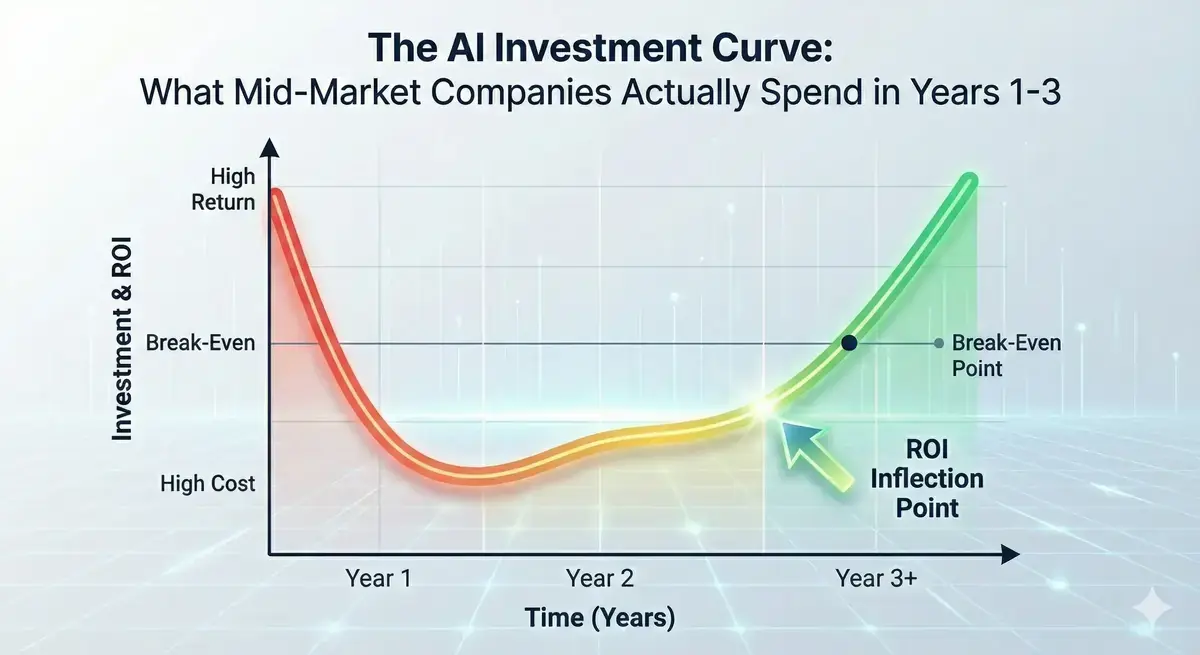
The AI Investment Curve: What Mid-Market Companies Actually Spend
Introduction: The ROI Credibility Crisis
Let's start with an uncomfortable number: 95%. That's the failure rate MIT Sloan Management Review reported for enterprise GenAI projects that don't meet ROI expectations. The number has been debated, but even conservative estimates put failure rates above 70%.
If you're a CFO evaluating AI investments, that statistic should make you deeply skeptical of the vendor pitch you heard last week—the one promising 40% cost reduction within a year. It should also make you question the breathless case studies where every implementation seems to pay for itself in months.
Here's the tension: the vendors aren't entirely wrong. AI can reduce costs. Significantly. The problem is that most companies are being sold a 3-month story when the real timeline is 3 years.
This matters for mid-market companies—those in the $100M to $1B revenue range—because you don't have the luxury of expensive failures. You can't throw $10 million at an AI initiative and write it off as "learning." Every technology dollar has to work.
This whitepaper offers something the vendor slides don't: an honest picture of what AI actually costs in Years 1 through 3, why costs typically rise before they fall, and what separates the companies that achieve real savings from the 95% that don't.
The thesis is simple: AI's cost-reduction promise is real, but it's a J-curve, not a hockey stick. Understanding that curve—and architecting for it—is the difference between joining the 95% and becoming a case study worth reading. For specific guidance on measuring returns throughout this journey, see our ROI best practices.
The Typical AI Investment Pattern
The industry talks about AI ROI as if it's a straightforward calculation: invest X, save Y, break even in Z months. The data tells a different story.
Deloitte's State of AI in the Enterprise report found that companies achieving meaningful AI ROI typically require 2 to 4 years—not the 7 to 12 months that vendor business cases assume. This isn't because AI doesn't work—it's because the real costs of implementation consistently exceed initial projections.
Why Year 1 Costs Rise
When companies begin AI initiatives, four cost categories typically expand simultaneously:
Discovery and Assessment. Before you can automate anything, you need to understand what you have. Most mid-market companies discover their data is messier, their systems more fragmented, and their processes more inconsistent than anyone realized. This assessment phase costs money—both in external expertise and internal time.
Data Infrastructure. AI runs on data. If your data lives in silos, requires manual extraction, or lacks consistent formatting, you're not ready for AI—you're ready for a data project. These infrastructure investments are necessary but often unplanned.
Training and Change Management. AI changes how people work. Even successful implementations face resistance, require new skills, and demand ongoing support. Most business cases underestimate these soft costs by 50% or more.
Pilot Projects That Don't Scale. Nearly every company runs pilots. Many succeed in controlled environments. Fewer than half scale to production. Each abandoned pilot represents sunk cost that doesn't appear in the vendor's ROI model.
The J-Curve of AI Investment
The honest investment curve looks like this:
- Year 0 (Baseline): Your current technology and operations spend
- Year 1: Spend increases 15-30% as you assess, build infrastructure, run pilots, and train staff
- Year 2: Spend stabilizes as successful initiatives reach production and failed ones are abandoned
- Year 3+: Net reduction begins as AI delivers on its efficiency promise
The numbers vary by scope, but the pattern is consistent. Per-employee AI costs during active implementation vary widely depending on scope and industry, but mid-market companies should plan for meaningful per-employee investment during the transition period—costs that materialize before savings do.
Meanwhile, most CEOs face pressure to demonstrate AI ROI quickly. This mismatch between expectation and reality explains why so many initiatives stall: leadership expects savings in Year 1 and pulls funding when costs rise instead.
Understanding the J-curve doesn't make it go away. But it does allow you to plan for it, budget for it, and avoid the panic-driven decisions that derail promising initiatives.
Why "Reduce Spend" Is Still True
If AI typically increases costs before reducing them, why pursue it at all? Because the endpoint is real—if you take the right path to get there.
The critical distinction isn't between "AI" and "no AI." It's between two fundamentally different approaches to implementation.
Path A: Add AI to Existing Complexity
This is the default path. Most companies layer AI tools onto their existing technology stack, existing processes, and existing organizational structure. They automate what they have rather than questioning whether they should have it.
The result: AI amplifies complexity instead of reducing it. You're now paying for legacy systems, new AI tools, integration between them, and the people required to manage all three. Costs compound. The J-curve never inflects downward.
This is how 95% of AI projects fail.
Path B: Use AI as a Forcing Function to Simplify
The companies that achieve real cost reduction use AI implementation as an opportunity to question everything. Which systems can be eliminated? Which processes exist only because humans couldn't handle the volume? Which integrations are workarounds for problems that AI solves directly?
This path is harder. It requires architectural decisions, not just technology decisions. It demands executive alignment on what to keep and what to kill. It means saying no to vendors who want to sell you point solutions.
But this path actually bends the curve.
Real-World Evidence
In implementations we've observed, companies using traditional monitoring approaches automate roughly 12% of operational tasks. Those that combine AI with architectural simplification—eliminating redundant systems, consolidating monitoring tools, standardizing processes—achieve automation rates approaching 75%, cutting IT operations costs in half.
Manufacturing shows similar patterns. AI-driven predictive maintenance has been shown to deliver significant cost reductions in maintenance spend—but only when combined with equipment standardization and process simplification. Companies that bolt predictive AI onto a patchwork of legacy equipment and inconsistent processes see far smaller gains.
The variable that matters most isn't which AI vendor you choose. It's whether you're willing to simplify your architecture while you automate your work.
The Mid-Market Advantage
Here's the contrarian view: mid-market companies are better positioned for AI ROI than enterprises.
This isn't the conventional wisdom. Most coverage focuses on large enterprises and their AI investments. The assumption is that scale equals advantage—bigger companies have more data, more resources, and more ability to absorb failed experiments.
The data suggests otherwise.
Speed to Value
Enterprise AI implementations typically take 12 to 18 months from pilot to production deployment. Mid-market companies regularly achieve the same milestone in 90 days. The reasons are structural:
- Fewer stakeholders to align
- Shorter approval chains
- Less organizational inertia
- Simpler (if messier) technology stacks
Speed matters because AI technology evolves rapidly. An 18-month implementation timeline means you're deploying yesterday's capabilities while your faster competitors are already on the next iteration.
The Legacy Debt Discount
Yes, mid-market companies have technical debt. But it's usually less than enterprises carry. A $500 million company might have 15 years of accumulated systems. A $50 billion company might have 40 years. That difference in legacy burden translates directly to implementation complexity and cost.
The Process Optimization Sweet Spot
Startups move fast but often lack processes worth optimizing. They're still figuring out what works. Enterprises have mature processes, but those processes are calcified—changing them requires organizational archaeology.
Mid-market companies occupy the sweet spot: established processes that have proven their value, but not so entrenched that changing them requires executive warfare.
The Gap Is Your Opportunity
Current data shows that 77% of companies with $10 billion or more in revenue are fully implementing AI initiatives (McKinsey State of AI, 2025). For mid-market companies, that figure is even lower — most are still in early stages of AI adoption.
This gap isn't evidence that mid-market companies are behind. It's evidence that the market is early. The companies that move now—and move correctly—have the opportunity to leapfrog competitors who either started late or started wrong.
The question isn't whether mid-market companies can compete with enterprises on AI. It's whether they can avoid making the same mistakes.
Ready to assess your organization's AI readiness? The Assessment evaluates your technology, data, people, and processes to identify what's blocking your AI success. Schedule your assessment →
What the Investment Curve Should Look Like
If the typical J-curve bends down in Year 3, a well-executed initiative can compress that timeline. Here's what the phases should look like for a mid-market company doing it right.
Phase 1: Assessment and Architecture Decisions (Months 1-3)
Objective: Understand what you have, decide what to keep, and identify where AI creates actual leverage.
Before you invest in AI tools, you need clarity on three questions:
- Which systems can be eliminated entirely?
- Which processes exist only to compensate for system limitations?
- Where does manual work create the highest cost with the lowest value?
This phase involves a structured assessment of your technology landscape, process workflows, and data accessibility. The goal isn't to inventory everything—it's to identify the 20% of your architecture that creates 80% of your AI opportunity.
Investment: Assessment ($25,000-$35,000) plus internal time for discovery sessions and documentation review.
Outcome: A prioritized roadmap that sequences architectural simplification with AI implementation. You'll know what to eliminate, what to consolidate, and what to automate—in that order.
Phase 2: Foundation Building (Months 4-12)
Objective: Create the architectural foundation that makes AI work.
This is where most companies skip steps and pay for it later. Foundation building includes:
- Data consolidation: Moving from fragmented silos to accessible, consistent data sources
- System simplification: Eliminating redundant tools, consolidating platforms, retiring legacy applications
- API enablement: Ensuring systems can talk to each other—and to AI tools—without manual intervention
- Initial automation: Low-risk, high-impact automations that deliver early wins while building organizational capability
Investment: Highly variable by scope. Typical mid-market foundation investments range from $100,000 to $500,000, including both technology and implementation costs. The variance depends on data fragmentation, number of systems to consolidate, and whether you're replacing legacy platforms or simply connecting them. The companies that underinvest here overpay in Phase 3.
Outcome: A simplified, connected technology platform that's actually ready for AI—not just "AI-adjacent."
Phase 3: Scaled Implementation (Year 2)
Objective: Deploy AI capabilities on the foundation you've built.
With a clean architecture in place, AI implementation becomes dramatically simpler. You're not building workarounds for data gaps or fighting integration battles. You're applying intelligence to workflows that are already streamlined.
This phase focuses on:
- Production deployment of AI capabilities tested during foundation building
- Expansion to adjacent use cases that leverage the same architectural investments
- Measurement and optimization of deployed solutions
Investment: Ongoing operational costs plus implementation resources. ROI begins offsetting investment during this phase.
Outcome: Measurable efficiency gains that appear in financial statements, not just pilot reports.
Phase 4: Compounding Returns (Year 3+)
Objective: Harvest the benefits of architectural decisions made in Year 1.
This is where the J-curve inflects sharply downward. Each improvement makes the next easier:
- Clean data accelerates every subsequent AI initiative
- Simplified systems reduce maintenance burden
- Organizational capability compounds—your team gets better at AI implementation with each project
Investment: Net reduction begins. New AI initiatives cost less to implement because the foundation exists.
Outcome: Sustainable competitive advantage. You're not just using AI; you're structured to adopt each generation of AI capability as it emerges—without starting over.
Questions to Ask Before You Invest
Before committing to AI investment, CFOs should be able to answer these questions honestly:
Do you know which systems you can eliminate? Most companies have 20-30% more applications than they need. If you can't identify the candidates for retirement, you're not ready to add new capabilities. Every system you keep is a system you'll eventually need to integrate with AI.
Is your data accessible via APIs? AI tools need programmatic access to data. If your critical business data requires manual extraction, reporting exports, or human interpretation, you have a data project before you have an AI project. The cost of that data project should be in your AI business case.
Do you have executive alignment on priorities? AI initiatives that succeed have clear executive sponsorship and organizational agreement on what matters most. If your leadership team can't agree on the top three processes to automate, you'll spend Year 1 in political battles instead of implementation.
Have you assessed the political barriers to change? Every automation affects someone's job. Some of those people have organizational power. Understanding where resistance will emerge—and whether leadership will support pushing through it—prevents expensive surprises mid-implementation.
What's your tolerance for short-term investment? The J-curve is real. If your organization panics when Year 1 costs rise, you'll abandon initiatives before they deliver value. CFOs who set realistic expectations with the board are more likely to see initiatives through to ROI.
Honest answers to these questions won't make AI implementation easy. But they'll tell you whether you're ready to start—or whether you have pre-work to do first.
Conclusion
AI will reduce costs for mid-market companies. The data supports it, the technology enables it, and the early movers are proving it.
But the timeline depends on your starting point.
Companies that add AI to existing complexity see the J-curve extend indefinitely—costs rising, ROI perpetually 18 months away. Companies that use AI as a forcing function to simplify see the curve compress. Year 1 costs rise purposefully. Year 2 stabilizes. Year 3 delivers.
The difference isn't technology. It's architecture. It's the willingness to eliminate before you automate.
For mid-market companies, the window is now. Less legacy debt than enterprises, more agility than you realize, and a chance to leapfrog competitors who started wrong or haven't started at all.
The first step: understand your real investment curve.
Take the Next Step
Understanding your real investment curve is the first step toward AI ROI that actually materializes. Tributary helps mid-market companies navigate AI implementation with clarity and confidence.
Take our free AI Readiness Assessment → to discover where your organization stands, or schedule a Strategic Assessment to get a prioritized roadmap, system consolidation recommendations, and a 3-year investment projection based on your actual architecture.
Ready to Put This Into Practice?
Take our free 5-minute assessment to see where your organization stands, or talk to us about your situation.
Not ready to talk? Stay in the loop.
Get AI strategy insights for mid-market leaders — no spam, unsubscribe anytime.
Related Posts
View all posts