How to Budget for AI in 2026: A CFO's Planning Guide
CFOs face a challenging paradox with AI budgeting: executives expect aggressive AI investment, yet they also demand rigorous financial justification. The board wants AI innovation, but finance needs concrete ROI projections.
Meanwhile, most AI budget requests are either wildly optimistic ("this will save us millions!") or frustratingly vague ("we need to invest in AI to stay competitive"). Neither approach survives CFO scrutiny.
Here's how to build an AI budget that's both ambitious and financially sound—one that gets approved and delivers measurable returns.
Understanding AI Budget Categories
AI spending doesn't fit neatly into traditional IT budget categories. You need a framework that captures the full picture.
Category 1: Tools and Technology
This is what most people think of as "AI spending," but it's more nuanced than buying software licenses.
Foundation Tools ($15K-50K annually for mid-market):
- API access to commercial AI models (OpenAI, Anthropic, Google)
- Specialized AI platforms for specific use cases (customer service, document processing, etc.)
- Development tools and frameworks for custom AI applications
- Testing and experimentation platforms
Enterprise AI Platforms ($50K-250K annually):
- Comprehensive AI platforms (Salesforce Einstein, Microsoft Azure AI, etc.)
- Industry-specific AI solutions (healthcare diagnostics, financial analysis, etc.)
- Custom model development and deployment infrastructure
Infrastructure (Varies widely):
- Cloud compute for training and inference (GPU/TPU resources)
- Data storage and processing capacity
- Network bandwidth for AI applications
- Development and production environments
Budget Reality: Start with foundation tools to prove value before committing to expensive platforms. Many mid-market companies waste money on enterprise platforms before they're ready to utilize them effectively. For a breakdown of detailed implementation costs, consider the full scope of what AI initiatives require.
Category 2: Talent and Expertise
AI technology is useless without people who can implement and manage it effectively.
Internal Talent (Per role annually):
- AI/ML Engineers: $120K-180K (mid-market salaries)
- Data Scientists: $100K-150K
- ML Operations Engineers: $110K-160K
- AI Product Managers: $100K-140K
- Prompt Engineers/AI Application Developers: $80K-120K
External Expertise:
- Implementation consultants: $150-300/hour
- Strategic advisory: $200-400/hour
- Specialized contractors for specific projects: $100-250/hour
Budget Reality: You probably don't need full-time AI specialists initially. Start with one strong technical lead (either hired or contracted) who can evaluate tools, manage implementations, and upskill existing staff. Add specialized roles as AI maturity grows.
Category 3: Training and Enablement
The most overlooked budget category is also one of the most critical for ROI.
Leadership Training ($5K-20K):
- Executive AI literacy programs
- Strategic AI planning workshops
- Change management for AI adoption
Technical Training ($10K-40K annually):
- Developer training on AI APIs and frameworks
- Data engineering skills development
- MLOps and model management training
Business User Enablement ($15K-50K annually):
- AI tool training for end users
- Best practices for working with AI
- Responsible AI usage guidelines
- Ongoing support and documentation
Budget Reality: Plan for 10-15% of your AI technology budget to go toward training. AI tools that users don't understand or trust won't deliver value no matter how sophisticated they are.
Category 4: Data Preparation and Management
AI is only as good as the data it's trained on. Many AI initiatives fail because companies underinvest in data readiness.
Data Infrastructure ($20K-100K initially, $10K-30K ongoing):
- Data pipeline development
- Data cleaning and normalization
- Data warehouse or lake expansion
- Integration between data sources
Data Quality ($15K-50K annually):
- Data validation and cleansing
- Master data management
- Data governance implementation
- Quality monitoring and metrics
Data Security and Compliance ($10K-40K annually):
- Data access controls
- Privacy-preserving techniques
- Compliance auditing
- Data retention and deletion policies
Budget Reality: If your data isn't already well-managed, expect to spend 30-40% of your first-year AI budget on data preparation. Trying to skip this creates expensive failures.
Ready to assess your organization's AI readiness? The Assessment evaluates your technology, data, people, and processes to identify what's blocking your AI success. Schedule your assessment →
Hidden Costs That Derail AI Budgets
The line items above are straightforward. The budget killers are the costs that don't appear in initial planning.
Integration Complexity
AI tools rarely work as standalone solutions. Integration with existing systems drives unexpected costs:
- Custom API development: $20K-100K per integration
- Data synchronization and ETL: $15K-60K per source system
- Legacy system modifications: $30K-150K depending on complexity
- Testing and validation: 20-30% of integration costs
How to Budget: Add 30-50% to vendor-quoted implementation costs to account for integration reality. Vendors estimate best-case scenarios; you need to plan for actual scenarios.
Change Management and Adoption
Technology costs are just the beginning. Getting people to actually use AI effectively drives significant soft costs:
- Productivity loss during transition: 10-20% for 2-3 months
- Process redesign and documentation: $15K-40K per major process
- Resistance management and communication: $10K-30K
- Pilot program costs before full rollout: $20K-60K
How to Budget: Include change management as a separate line item at 15-20% of total AI project costs. Treat it as seriously as technology expenses.
Ongoing Optimization and Maintenance
AI systems aren't "set and forget." They require continuous attention:
- Model performance monitoring and retraining: 10-20% of development costs annually
- Prompt engineering and refinement: $15K-40K annually
- Security updates and vulnerability management: $10K-25K annually
- Vendor relationship management and optimization: $5K-15K annually
How to Budget: Plan for ongoing costs of 20-30% of initial implementation costs per year. AI that isn't maintained degrades in performance and value.
Failed Experiments
Not every AI initiative succeeds. Budget for learning:
- Proof of concept projects that don't scale: expect 30-40% to fail
- Vendor evaluations that don't result in purchases: $5K-15K per evaluation
- Technical debt from abandoned experiments: $10K-30K to clean up
- Opportunity costs from misdirected efforts
How to Budget: Create a separate innovation budget for AI experimentation at 10-15% of total AI spending. This allows learning without derailing core initiatives when experiments fail.
A Phased Investment Approach
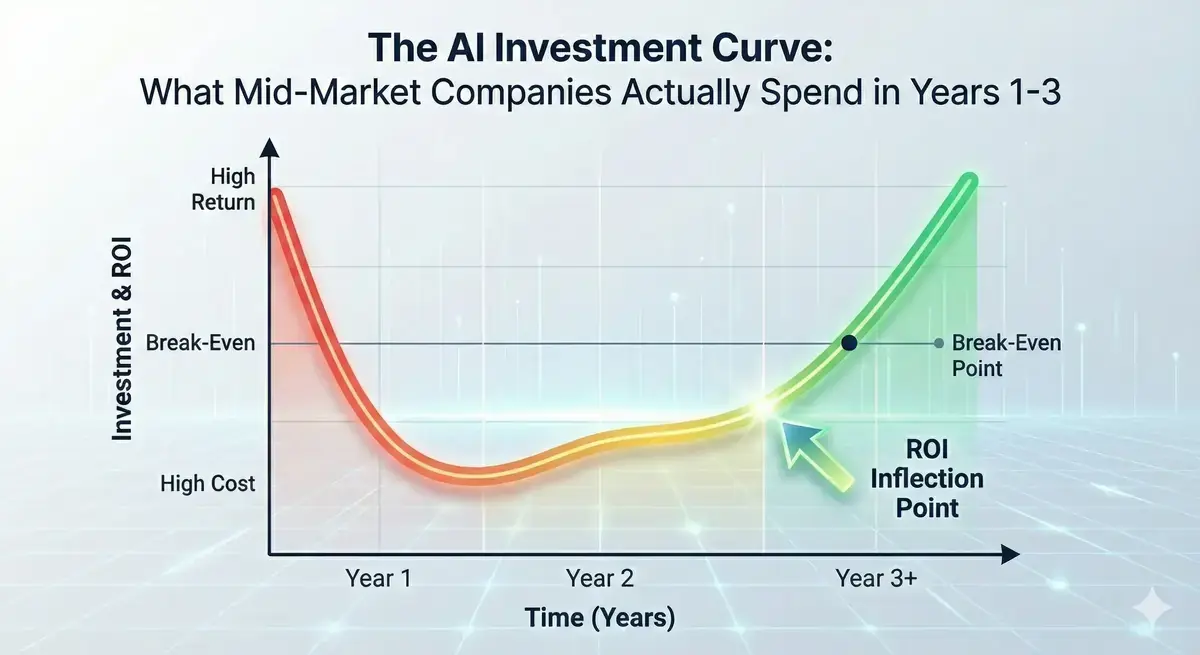
Smart AI budgeting isn't about committing to a three-year plan. It's about staged investments that prove value before scaling.
Phase 1: Foundation (Months 1-6, $50K-150K)
Objectives: Prove AI value, build capability, establish governance
Investments:
- Commercial AI tool subscriptions for high-value use cases ($15K-40K)
- One technical lead (hired or contracted) to drive implementation ($50K-80K for 6 months)
- Data assessment and initial cleanup ($10K-30K)
- Leadership training and strategy development ($5K-15K)
- Initial experimentation budget ($10K-20K)
Success Metrics:
- One AI application delivering measurable business value
- Technical capability to evaluate and implement AI tools
- Clear roadmap for expanding AI use cases
- Executive alignment on AI strategy and investment
Phase 2: Expansion (Months 7-12, $100K-300K)
Objectives: Scale successful use cases, build internal expertise, improve data foundation
Investments:
- Expanded AI platform capabilities ($30K-80K)
- Additional technical talent or consulting support ($40K-120K)
- Data infrastructure improvements ($20K-60K)
- Business user training and enablement ($15K-40K)
- Integration development ($20K-60K)
Success Metrics:
- 3-5 AI applications in production
- Demonstrated ROI exceeding investment
- Established AI development and deployment processes
- Growing internal AI literacy across the organization
Phase 3: Maturation (Year 2, $200K-600K)
Objectives: Institutionalize AI capabilities, drive continuous innovation, optimize investments
Investments:
- Comprehensive AI platform or multiple specialized tools ($60K-200K)
- Build out AI team with specialized roles ($100K-300K)
- Advanced data management and governance ($30K-80K)
- Expanded training and certification programs ($20K-50K)
- Innovation lab for emerging AI capabilities ($20K-60K)
Success Metrics:
- AI embedded in core business processes
- Self-sustaining AI capability with internal expertise
- Continuous pipeline of new AI initiatives
- Clear competitive advantage from AI capabilities
The Key Principle: Each phase funds itself. Don't proceed to the next phase until current investments demonstrate value that justifies expansion.
Making the Business Case
CFOs approve budgets that show clear financial returns. Here's how to build a compelling case:
Quantify Expected Benefits
Move beyond "efficiency improvements" to specific financial impacts:
Cost Reduction Examples:
- Customer service AI: $80K annually in reduced support costs (3 FTE equivalent)
- Document processing automation: $45K annually in processing costs (1.5 FTE equivalent)
- Predictive maintenance: $120K annually in reduced downtime and emergency repairs
Revenue Enhancement Examples:
- Personalized recommendations: 8-12% increase in cross-sell conversion
- Lead scoring and prioritization: 15-20% improvement in sales efficiency
- Dynamic pricing optimization: 3-5% margin improvement
Risk Reduction Examples:
- Fraud detection: Prevent $200K+ in annual fraud losses
- Compliance automation: Reduce audit costs by $30K annually, avoid $500K+ in potential penalties
- Cybersecurity improvements: Reduce breach probability and potential $1M+ incident costs
The Formula: Be conservative in benefit estimates and specific about assumptions. "Could save up to..." is less credible than "Based on processing 50,000 documents at $8 per document, automation saves $400K annually."
Account for Implementation Risk
Acknowledge risks and mitigation strategies:
- Technology Risk: Tools may not perform as expected—mitigate with proof of concept before full investment
- Adoption Risk: Users may resist change—mitigate with change management budget and phased rollout
- Integration Risk: Complexity may exceed estimates—mitigate with conservative timelines and contingency budget
- Vendor Risk: Providers may change pricing or discontinue services—mitigate with strategic vendor selection and contract terms
Why This Matters: CFOs trust budget requests that acknowledge risks more than those that promise unrealistic certainty.
Show Competitive Context
Position AI investment relative to competitive dynamics:
- Industry benchmarks for AI spending as percentage of IT budget (typically 5-15% for early adopters)
- Competitor AI capabilities and market positioning
- Customer expectations for AI-enhanced experiences
- Regulatory or industry requirements driving AI adoption
The Argument: "Competitors are investing 10% of IT budget in AI while we're at 3%. This gap translates to concrete disadvantages in customer service response times, operational efficiency, and product capabilities."
Build Optionality
Structure budgets to minimize downside while preserving upside:
- Emphasize subscription/usage-based pricing over large capital investments
- Highlight ability to scale spending up or down based on results
- Show decision points where investment can be paused if results don't materialize
- Demonstrate how learnings from small investments inform larger ones
Why This Matters: CFOs prefer budgets that allow course correction to those that require irrevocable commitments.
Budget Success Metrics
How do you know if you're spending AI budget effectively? Track these indicators:
Financial Metrics:
- ROI by AI initiative (target: 200-300% in Year 1, 300-500% in Year 2)
- Cost per use case implementation (should decrease as capability matures)
- Total cost of ownership vs. initial budget estimates (target: within 10-15%)
Operational Metrics:
- Time from concept to production deployment (should decrease over time)
- Percentage of AI initiatives delivering planned value (target: 60-70%)
- AI tool utilization rates (target: 70%+ of licensed capacity actively used)
Strategic Metrics:
- Business process coverage (percentage of key processes with AI enhancement)
- Internal AI capability growth (headcount, certifications, project completions)
- Competitive positioning improvements attributed to AI
The Goal: Demonstrate that AI spending delivers measurable value, not just activity.
Common Budgeting Mistakes to Avoid
Mistake 1: Technology-First Budgeting
Building budgets around specific technologies rather than business outcomes leads to expensive tools that don't deliver value.
Instead: Start with business problems worth solving, then budget for AI approaches that address them.
Mistake 2: Underestimating Data Costs
Assuming existing data is "AI-ready" leads to massive budget overruns when reality hits.
Instead: Invest in data assessment early and budget realistically for data preparation.
Mistake 3: All-or-Nothing Investments
Committing large budgets to unproven AI initiatives creates either spectacular waste or risk-averse paralysis.
Instead: Use phased investments where each stage proves value before the next is funded.
Mistake 4: Ignoring People Costs
Focusing budget on technology while underinvesting in training and change management dooms adoption.
Instead: Budget 20-30% of total AI spending for training, change management, and enablement.
Mistake 5: No Innovation Buffer
Spending entire budget on planned initiatives leaves no room for emerging opportunities or necessary course corrections.
Instead: Hold 10-15% of budget in reserve for experimentation and unexpected opportunities.
Your AI Budget Planning Checklist
- Define clear business objectives for AI investment with measurable outcomes
- Assess current state of data, infrastructure, and skills honestly
- Build phased investment plan with clear go/no-go decision points
- Include all cost categories: tools, talent, training, data, integration, change management
- Add contingency of 20-30% for hidden costs and complexity
- Establish ROI metrics and tracking mechanisms before spending
- Plan for optimization with ongoing budget for maintenance and improvement
- Create innovation reserve for experiments and emerging opportunities
- Document assumptions and risk mitigation strategies
- Build executive alignment on objectives, timeline, and success criteria
AI budgeting isn't about predicting the future perfectly. It's about making smart bets, proving value incrementally, and adjusting course based on results.
The companies succeeding with AI aren't those with the biggest budgets. They're those with the most disciplined approach to investing, measuring, and learning.
Take the Next Step
A well-structured AI budget is the difference between investment that delivers measurable returns and expensive experimentation. Tributary helps mid-market companies navigate AI implementation with clarity and confidence.
Take our free AI Readiness Assessment → to discover where your organization stands, or schedule a consultation to build a realistic AI investment plan that gets approved and delivers results.
Ready to Put This Into Practice?
Take our free 5-minute assessment to see where your organization stands, or talk to us about your situation.
Not ready to talk? Stay in the loop.
Get AI strategy insights for mid-market leaders — no spam, unsubscribe anytime.
Related Posts
View all posts